Mike Map


View Mike Map in a larger map

Saturday, March 19, 2011

Next Article

The following article was printed in In Daegu, a new newspaper from the makers of Daegu Pockets.


The full text and Korean translation follow.
To download the pdf, click here.

Have you ever been sitting at a Daegu bus stop, watching the ticker and wondering why the bus you’re waiting for doesn’t seem to be getting any closer, when all of a sudden a packmof shiny spandex-clad cyclists races by? Hundreds of men, women, and children riding bikes of all different types and sizes, from giant unicycles to low-riding, stylized tricycles, from million-won designer models to that rusty one that has been lying on its side next to KNU’s North Gate for at least three months now. What are they all doing?

Welcome to the Daegu Bike Festival. Funded by Daegu City Hall and organized by the Daegu Council for Local Agenda 21 (맑고푸른대구21추진현의회), the DBF is an opportunity for cyclists of all shapes and sizes, ages, races, and levels of ability and dedication to enjoy themselves while at the same time demonstrating that Daegu is indeed a bikeable city. From humble beginnings in 2006, the DBF has grown into an event that regularly attracts hundreds of riders, and sometimes more – over one thousand people participated in last October’s event, the Daegu Bike Rally, a leisurely 25 kilometer course from Daegu World Cup Stadium to the main gate of Keimyung Univeristy. (Actually, all the way to the cafeteria. Followed by free lunch.) Other rides last year included a scenic ride along the Nakdong River in May and a loop from downtown to Dusan intersection and back to celebrate Daegu Car-Free day in September. Every ride begins with signing in and picking up your raffle ticket and ends with dozens of gifts, ranging from the small (helmets) to the big (bicycles) to the just plain strange (environmentally-friendly frying pans).

The DBF represents more than just a chance to win some free stuff, though. For the chronically lost, the process of finding the starting location, following the course, and making your way back home from the destination is an excellent way to learn the layout of the city, while the chronically bored may encounter restaurants and shops that might otherwise have gone unknown. If thoughts of giant carbon footprints weigh heavy on your conscience, DBF events may be a chance to get started doing some good. If you’re interested in bicycles, bike fashion, or bike-mounted gizmos, you’ll have plenty to feast your eyes on. For those looking to meet other bicycle enthusiasts to arrange rides with, there’s no better place to be. If you like to feel important, you can ride at the front of the pack, right next to the police escorts. And if you’ve been waiting for an opportunity to parade around in public wearing spandex, well...you aren’t alone.

The final DBF event of 2010, a 14-km ride along the banks of the Geumhogang River, took place in November. DBF will begin its 2011 campaign on March 26th (hopefully the cold will have passed by then) with a ride starting out in front of the West District Office (서구청). The exact time and course have yet to be decided; for up-to-date information, and to register for future events, have a look at http://www.ecobike.org.

DBF events are always free of charge and always open to one and all. So far, few foreigners have heard about or participated regularly in the festivities. This year, let’s ride together in order to raise awareness, while at the same time helping to make a cleaner, healthier, more friendly Daegu.

--------------------------------------

If you're interested in finding out about eco-friendly restaurants, shops, and events in Daegu, please visit http://noksaeksari.blogspot.com or find the group 녹색살이대구 / Daegu Green Living on Facebook. Feel free to stop by one of our monthly Eco-film nights, held downtown at Buy the Book.

대구 버스정류장에 앉아서 전기 간판을 바라보며 당신이 기다리는 버스가 왜 오지 않는지 궁금해 할 때, 갑자기 반짝이는 스판덱스를 입은 수백 명의 사이클리스트들이 순식간에 지나가는 것을 본 적이 있나요? 남녀노소 없이, 다양한 사람을이 다양한 자전거 – 커다란 외발 자전거에서 누워서 타는 세발 자전거까지, 백만원을 호가하는 명품 자전거에서 경대 북3개월 이상 망치되어 누워 있는 녹슨 저전거까지 – 를 타고 다닌다. 신기하지요? 그들은 무엇을 하고 있을까요?

대구 자전거 대행진 (DBF) 것을 환영합니다. 대구 시청의 재정 지원을 받아 맑고푸른대구21추진협의회가 진행하는 자전거대행진은, 체격과 나이, 인종과 실력, 참여 경혐과 상관없이 많은 사람들이 즐거운 시간을 보낼 수 있다. 동시에 대구가 저전거로 쉽게 다닐 있는 도시임을 입중할 수 있는 좋은 기회이다.

2006년에 시작된DBF의 처음은 미약했지만, 계속해서 많은 사람들이 참여하면서 이제는 수백 명의 사람들이 참여하는 행사가 되었다. 작년 10월의 대구 자전거 랠리 (대구 월드컵경기장에서 성서계대정문까지 25km코스를 편안히 따라간)에는 천명 이상이 참여했다. (사실, 계대 안 식당까지 갔지요. 밥을 공짜로 먹기도 했고.) 작년 행사에는 5월의 낙동강을 따라 간 코스와 9월 “대구 차가 없는 날”을 경축하기를 위한 시내에서 두산오거리 일주를 거치오는 코스가 있었다. 모든 행사는 접수하고 경품권을 받는 것으로 시작되며, 수십 개의 경품 – 작은 것 (헬멧)과 큰 것 (자전거), 이상한 것도 (친환경 후라이팬) – 을 선물하는 것으로 끝난다.

하지만DBF는경품을 얻는 기회만 있는 것은 아니다. 길치에게는, 출발지를 찾고 코스를 따르고 집에 다시 돌아 가는 길을 찾는 과정에서 우리의 대구광역시의 모습을 배울 수 있을 것이다. 또한, 만성적으로 심심한 사람들은 알 수 없었던 식당과 가게를 맞닥뜨릴지도 모른다. 자동차가 뿜어내는 오염에 대해서 많이 고민하는 사람들에게는, DBF는 좋은 일을 시작할 기회가 될 수도 있다. 만약에 자전거와 저전거 패션, 그리고 최신 자전거 악세서리에 관심이 있다면, 구경할 것들이 많을 것이다. 자전거를 좋아하는 친구를 찾는다면, 이보다 더 좋은 곳이 없을 것이다. 주목받고 싶다면 경찰 호위대 바로 옆에 타면 되고요. 마지막으로는, 스판덱스를 입고 잘난 척할 핑계를 찾는다면, 이곳으로 오세요. 당신이 혼자가 아니다.

2010년의 마지막 행사는 11월 금호강을 14km 따라 가는 코스이었다. 2011년의 캠페인은, 추위가 지난 다음에 3 26일 서구청 앞마당에서 시작될 예정이다. 그행사의 시간과 코스는 아직 정확하게 정해지지 않았다. 그래서 자세한 정보를 찾고 싶거나 앞으로 진행될 행사에 신청하려면, http://www.ecobike.org에 접속하면 된다.

DBF은 늘 무료로 진행되고 누구나 참여할 수 있다. 지금까지는 대구 자전거 대행진에 대해 잘 알고 정지적으로 참여하는 외국인이 매우 적었다. 올해는 저전거를 같이 타는 것을 통해서 사람들의 인식을 높이는 동시에 깨끗하고, 건강하고, 사랑스러운 대구를 만들도록 노력합시다.

______________________________

다른 친환경 식당, 가게ㅘ 행사를 더 알고 싶다면 http://noksaeksari.blogspot.com 방문하거나 페이스북에서 녹색살이대구 / Daegu Green Living 이라는 그룹을 찾아 보는 것이 도움이 될 것이다. 매월 시내 Buy the Book에서 상영될 친환경 영화 관람에 누구든지 환영합니다.


Some slightly good news for pigs, amidst lots of really terrible news.

Wrote this for the other blog, but it's personal enough to reprint herre:

_________________________

I believe that we all have our "veg buttons." Soft spots that, when poked, make us cringe a little more than we expected, that activate our introspection, our guilt, our sense of right and wrong. If the right veg buttons get pushed, and often enough, and at the right times, one begins to feel differently about vegetarianism. One doesn't immediately begin to think it's absolutely right, or that it's the only way, but automatic reactions and unquestioned assumptions - "they're not human," "out of sight, out of mind," "I need it," "I have a right to it," open up, get exposed, become vulnerable. A little prodding feeling - maybe there's something to this? Those who try it aren't crazy. It becomes something to consider seriously, and even try.

For me, there were three such buttons. First came a plain piece of paper taped to the wall at my parents' church, saying that it takes tens of thousands of gallons of water to get a kilogram of industrially-raised beef. It didn't change my behavior at all, but it has stayed in my head for years and years. What's the point of taking short showers, and wishing that others would too, when my occasional trip to Outback uses up more water than a month's worth of hygiene habits?

Second was a truckbed full of pigs that I saw here in Korea. I wasn't even out in the countryside - actually, I was on my way to Costco. There were four or five pigs in the back of a decent-sized truck. They weren't squished in or anything. But one pig - and there's no pretty way to say this - had what I can only describe as a couple giant malignant ass polpys. (Ok, to be honest, I could also describe them as giant rectal warts.) I should probably describe them in detail for multiple impact, but I couldn't do it justice and the mere thought of trying makes me want to vomit. I didn't go veg for another year or more after seeing them, but from that day on, each time I sat down to grill some pork, the image floated up in my mind. Could this very bite be from that pig, or one just like it?

Third was something Michael Pollan said about poop. Before agriculture depended on chemical fertilizers, it depended on natural ones; feces were a resource. Animals evacuate, bacteria break down, plants absorb, animals eat, and evacuate again, and humans step in every now and then to skim a little surplus off the top of the process. Now, though, the bacteria don't break down poop, because it goes to giant lagoons where nothing can grow, not to fields where other lifeforms can make use of it. Thus, whatever nutrients are in the poo are unrecoverable, wasted; we have to turn to chemical fertilizers, and the oil that it takes to make them. The fertilizer runs into rivers and oceans and disrupts natural patterns; the oil burns off into the air and does the same. Things may have not been easy or perfect or ideal before before, but somehow, for some reason, we took a closed-loop solution and made two, if not three or more, problems out of it. Now we have a waste problem (what to do with all that shit?), and a fertility problem (how can we grow enough to feed all these animals). The answer is right in front of us. We spent millennia living with the answer. How can I keep eating meat when I know it contributes to this kind of ridiculousness?*

So, those were my veg buttons, or at least the big ones, the ones I remember, the ones I still think about. It seems that, recently, many Koreans have had their veg buttons pushed - not by churches or polyps or Pollan, but buy the outbreak of foot-and-mouth disease. Reports of millions of pigs and hundreds of thousands of cows being killed, often buried alive; speed bumps that shoot up geysers of chemical baths, and highway tollgates that get you from both sides; quarantines and canceled trips; chemical-soaked carpets in train station; increased food prices. According to this article,, "Disgust over FMD gives boost to vegetarianism" from the Jungang Daily , interest in vegetarian (and even vegan!) eating practices is on the rise**. The vegetarian buffet at Seoul National University's music school is filling up, and visits to the Korean Vegetarian Union website have quadrupled. The outbreak has shaken some people from ignorance into awareness, and some from awareness into action. If there's one good thing that can come out of the various crises we face - whether they're related to the environment, to energy, or to livestock - it's this: they make us face up to what we're doing, or what we're allowing other to do instead. They force us to confront our actions, our systems, and ourselves, and the necessity of changing them all.

What a good time to be trying to find a role as a vegetarian/environmental activist in South Korea!***

_________________________

*I know that the solution is not easy, and that there's no way now to just capture all the shit and take it Idaho.
** I owe the link to Mipa at Alien's Day Out
***At first I wanted to make a joke, starting that sentence off with "It's a bad time to be a pig, but..." Then I reconsidered. Too lewd?

It's the first ray-ee-nee day, of the year.

A one month post dearth! A deep, unsightly gash in my blog's epidermis! The agony of a stifled desire to write, to share to good news, to recount excursions undertaken and lessons learned. To record anything and everything, for you, for me, for posterity. Time lost, thoughts unrecoverable, a black hole in my memory. And perhaps, lacking news from me, in your heart as well?

If so, I apologize. I'll make it up to you.

Today, I intend to put an end to all of the above. Because:

It's raining.
And I've got a sore throat.
And a giant pitcher of homemade honey jujube tea.
And a bag full of muffin top cookies made by my friend Sandy.
And, for the first time in what feels like forever, not a single obligation.
And a billion things that I want to share.

This post is just preliminary though. First, I think I need to take a nap and make a list and pot some plants. Then I'll be back.

In the meantime, watch this video! I originally started this blog thinking I'd be telling my friends what South Korea is like. How people live, how they play, how they talk, what they eat, where they go, stuff like that. All the little, mundane trivia that constitute "knowledge" of a place and its people. Over the past year, though, I think I've replaced whatever amount of "cultural relaying" that I was doing with a bunch of stuff about my fauxboing and experiments and opinions.

Which is to say, this video is a million times better than any official "Sparkling Korea" (I could do a whole post on ridiculous city monikers) toursit-lure video I've ever seen. Maybe it's just the histper-friendly soundtrack and editing, I don't know. But the way the scenes are cut to the beat, and the way the protagonists reappear a few times, makes the video feel like it comes from the heart (whereas official ones tend to feel like they came from the boardroom.)


(If you'd like, compare it to the official ones, search for "Korea Sparkling" or "Korea Inspiring" on YouTube.)

Wednesday, February 16, 2011

12000 Chickens.

2011 has been a slow year for blogging so far! I'd like to think it's because I've been keeping busy...


After the Idli party, I spent a few more days with Sadhana friends, then took a couchsurfer from Colombia, Jorge. A really nice, cool guy. He stayed for a week and we hung out a fair bit; I really had nothing to do except study Korean, write another article for Daegu pockets, translate it, and eat the candy he brought as a gift. After a week or so, he and his friend Isabel (who was staying with another host) found their own place near another university, where they're going to TA for Spanish classes while taking an intensive Korean course. I have already told them that they can repay my kindness by cooking me an occasional vegan Colombian dinner. Next semester is shaping up nicely...

I had planned to head off on my farming excursions around the beginning of February, but as Lunar New Year fell on the 2nd, 3rd, and 4th, the farmers asked me to postpone my visit until the following Monday. So, I spent Korean New Year alone recuperating from about 5 weeks straight of being excessively social (Christmas group trip, New Year's group trip, continuous Upo wetlands camp prep meetings, early January visit to see friends in Seoul, various environmental things in Daegu, Tobin's visit, Idli party, Couchsurfers), napping and reading and studying Korean and cooking and such goodness.

So, come Monday the 7th, I came out to NunbiSan Maeul (Snow-Rain-Mountain Village), a chicken farm about 3 hours northwest of Daegu. I found out about Nunbi not through WWOOF, but through Seon-ju, a Korean friend I met in Sadhana. She spent most of the last 5 years visiting different kinds of communities - Buddhist, self-sufficient, sustainable, et. al. - in Japan and southeast Asia, and she knows of some stuff here in Korea too. She hadn't been here yet but asked me to check it out.

"Chicken farm" isn't exactly the best way to describe Nunbi, but I don't know what is. I can't post any pictures now, but later I'll show you the 7 buildings, each divided into 10 or 25 smaller rooms, holding a total of abotu 12,000 chickens. You could walk a circle around the whole set of buildings in about five or ten minutes; it's not too big, but it's big enough that the chickens have ample space to walk, jump, exercise, and do their chicken culture stuff.

The design for the coops was apparently invented by a Japanese farmer named (something like) Yamagasi - I've only heard the name in passing and haven't seen it written yet. Wooden beams run the length of the back of each coop; the chickens jump up onto them to sleep, and since they're about a foot off the ground, the chickens can poop without stepping in it and dragging it all around. The water is in a tray at the front of the coop, far from the feces. The space in the middle has some troughts for food, and on the left and right side, hanging off the walls, are big triangular boxes. The base of the triangle is filled with hay, and the hypotenuse blocks out sun and light, so that the chickens have a dark, soft, warm place to lay their eggs. When the farmers/workers/members of the community come in, all they have to do is open up the hypotenuse, grab the eggs out of the hay, and move on. Because the boxes are so nice, the chickens hardly ever lay eggs on the ground, which mean few get stepped on, missed, or wasted.

The eggs that Nunbi produces are fertilized, which means that if they were left alone they'd hatch into baby chicks. This may sound a little cruel - actually, the chairman of the community, when he heard about my veganism, said that he'd rather eat unfertilized eggs than fertilized ones, which is an argument I understand - but the truth is that fertilized eggs mean happier chickens. Here at Nunbi, the ratio of roosters to hens is about 1:12-15, which gives an egg fertilization rate of about 95%. I'm not sure what the "natural" ratio would be, but in many standard (sterile) egg operations, the hens never encounter a male and thus never get a chance to mate or have a child. To me, this looks like their ability to express one of the fundamental traits of animals is being denied. Not only the physical acts of mating, conceiving, and laying, but also the social acts of courting, competing, showing off, or however chickens get on with it. I don't think one has to know the details in order to acknowledge the justice of allowing them some amount of freedom. Furthermore, even if roosters were present in most egg-laying operations, mating would probably be impossible, since the conditions are so cramped that the chickens can hardly move around, let alone strut, play, or mount one another. Fertilized eggs don't guarantee that the chickens have space to move, but they raise the likelihood. Finally, chickens in standard egg operations don't even live through full life cycles. After being caged and manipluated and worn out (by antibiotics, "enhanced" feed, and non-natural light cycles), they're killed as soon as their productivity drops. Most of these chickens, bread for egg-laying ability and not survival capacity, wouldn't even survive if let loose, even into good conditions; their bodies are weak, and since they never saw adult chickens foraging or mating, they have no clue how to get by. Fertilized eggs mean, at least to some degree, that the chickens have been allowed to express some of their chicken-ness. And there's no such thing as animal welfare without this freedom.

So, for 2 days, I woke up at 6:30, put on some nice tall boots, and went outside to pour hot water on the faucets, which freeze every night. Once they faucets are operational, the water is turned on so the chickens can drink. (In the non-freezing months, it's always on). Then I went through the coops with the young chickens, who haven't quite adjusted to the "don't lay your eggs in your own poop" system. I would throw a few handfuls of seed into the corner, and and with the chickens distracted and scattered, I was able to clearly spot and pick up the eggs that had been laid on the ground. If I saw a chicken preparing to lay an egg anywhere other than in the egg box, I picked it up and moved it to the egg box, both for its own comfort and ours. After a time or two, the chickens pick up the habit, and by the time they're six months old, they hardly lay on the floor at all.

Breakfast at 8:00, then back to the chickens at 9:00. We opened up the rooves to let the sunlight in, then one more round picking up eggs from the floor - yes, they lay them that frequently - then gathering from the egg boxes. A room with 100 chickens might produce about 50 eggs overnight. The eggs are set into temporary cartions, and then we drive them down to the little factory, where they are stored for the moment. Then we weigh out a bag of feed for each room (10 to 20 kg depending on the size of the room and the age of its inhabitants) and set it out in front of the door. Then we head in for lunch and a nap.

At 2pm, back to the chickens. They have a special long coo for when they're hungry, which I don't think I can transcribe. The tone is kind of plaintive (maybe that's just me projecting) and moves from low to high. Entering the coop, I'd toss some feed in one corner to get them out of the way, flip over their troughs to empty them out (chickens are not the brightest animals and often stand and poo inside the trough while eating), and then fill them with new goodies.

After that, miscellaneous time. On the first day, we made a special snack out of the eggs that were too ugly or damaged to sell. We boiled several hundred defective eggs, then mixed them (shells and all) with some organic nutrition supplements and some rice husks, and then I donned my boots again and stomped on the stuff until it got kind of pasty-clumpy. It was like taking a bath in a tub of scrambled eggs; I was half salivating and half ready to puke. Then we distributed it to the young chickens as a sort of protein supplement.

The idea of feeding eggs to chickens struck me as somehwere between stupid and inhumane. But, actually, if you watch chickens, you'll quickly see that if you accidentally break an egg in their presence, they race over and gobble it right up; this has been explained to me as an attempt to recover the protein and other nutrients that their bodies jettison each day in the process of laying. They won't break intact eggs open - that would be a truly stupid, maladaptive habit - but eggs that have no chance of developing into chicks are fair game.

The next day, for the older chickens, we fed them something one of the farmers called "corn kimchi." They had grown corn the previous summer and kept it fermenting for months and months, kernels and cobs and stalks and all. The rancid, rotten, stinky smell means that the corn is full of little living bacteria, probiotics, which are good for the chickens' digestion and overall health around this time of year. They loved it.

After that, one more round of picking up ground eggs. Then all the eggs are brought to the factory, which has fifteen meters of conveyor belts that bring the eggs through six or seven different machines. The machines wash the blood, feathers, dirt, and poo off the eggs, sort them according to size, enter all sorts of statistics into the computer, and then drop them into cartons.

While the people in the factory are setting up the eggs for distribution, the people outside get the chickens ready for bed. Turn off the water, close the roofs, lower the windscreens, and coax the chickens into their sleeping spots (stragglers who attempt to sleep away from the flock often catch colds, so it's important to put them all together). Once the sun sets and the chickens are OK, the workers can head in for dinner.

Nunbi has an interesting dynamic. About ten or twelve people work here; some of them are alone, living in the dorm, eating communal meals, while others live nearby with their families. Together they produce between eight and ten thousand eggs a day, all of which are sold to Hansallim ("One Life," or maybe "Korean Life"), an organization that runs a chain of environmentally-friendly supermarkets. Regardless of his or her role, each worker receives an equal share of the profits, after some has been set aside to donate to local causes and for the development of the facilities. The people who stay in the dorm - actually, "research center" - hang out together in the evenings, drinking tea and chatting and reading and practicing "Guk-seon-do," a reportedly ten-thousand year old Korean style of Tai-chi/yoga/martial arts/meditation on Wednesdays.

I've only spent 3 of the last 10 days at Nunbi and have a lot to write about Heuksallim (Saving the Soil), the organization where I spent the rest of my time. But, it's nearly lunch time, and after I eat, I'm heading off for another ten days of noble silence. That's right, my second Vipassana of the year! I didn't think I'd have another chance until next summer, but the founder of Nunbi knew about an unlisted course happening not to far from here and set me up. I'm not sure whether I'll volunteer (i.e. cook, clean, etc, meditating only about 3 hours a day) or whether I'll full-on participate (ten or twelve hours of meditation daily), but either way, I won't be back until just about March. See ya then...

Thursday, February 03, 2011

16평, 26명 (Sixteen Pyeong, Twenty-six Myeong)

This post is about Idli. And Dosai. And potlucks. And international friendships. And claustrophobia.

Ask anyone who's spent time at Sadhana to relate some of their best memories to you, and there are a few things you'll definitely hear:
- Dance parties and bonfires
- Living, eating, working, and playing with a group of amazing if eccentric people from all over the world
- Wiping with your hand.
- Tropical fruit salad for breakfast every morning (papaya, pineapple, pomegranate, banana, guava, chicoo, orange, coconut, cilantro, mint...)
- Skipping first work during the week or breakfast on the weekends to bike into town for Idli and Dosai.

Four of those things are self-explanatory, one is awesome but, unfortunately, unspeakable, and one may be a mystery to some of you. It's this last one that I'd like to explain.

When we think of Indian food, we generally think of stuff like tandoori, vindaloo, palak paneer, aloo gobi, channa masala, etc, served with raitha, naan, roti, paratha, and chapathi, and maybe a lassi at the end. What we aren't usually aware of, though, is that this stuff is all north Indian, and not representative of the country's cuisine as a whole. North Indians have left home and spread around the world a bit more than southerners - there are surely historical and political reasons for this, such as Delhi being in the North, but I really have no idea - and, thus, so is their cuisine.

Due to the different climate, and particularly the difference in rainfall, the south grows different crops and eats different fare. The dependable monsoons, and the water they bring with them, make the environment more suitable for rice and less suitable for wheat. This is why, in Tamil Nadu, naan, roti, and chapathi are generally found only at slightly largel "hotel" restaurants. When you want to run down the street and find the closest, cheapest, hole-in-the-wall, this-is-what-people-who-work-in-the-fields-eat, sort of place, idli and dosai are what you get.

For lack of better comparisons, I'd say that dosai are more or less rice pancakes and idli are...ehr...rice muffins? Anyway, without further ado, here's what they look like, and then there's how you make them:


1) Mix long-grain white rice and urad dahl, 2:1. (1 cup of rice and 1/2 a cup of dahl will make enough batter for about 20 idli, or maybe 6 dosai.)

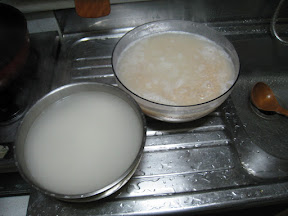
2) Soak for 24 hours. Make sure to put in plenty of water, since lots of it will get absorbed. (You can start with hot water to make sure it all gets soft.)


3) Blend mixture together until it's a bit foamy and not too grainy. Add water slowly, lest it get too runny.


4) Add more water and soak for another 24 hours. You should be able to smell a little sour scent - this means it's fermenting properly.

The batter can be preserved in this state -if the ambient temperature isn't too hot, you can leave the batter out for a few days, while if it's warm, you can store it for a week or so in the fridge.

To turn the batter into idli:

5a) Start boiling a bit of water in a large pot, or pressure cooker if you have one.

6a) Use a little bit of oil to grease your idli steamer trays (visible in my hands there.)


7a) Spoon out a bit of broth into each idli mold.

8a) Stack your trays up and start steaming. Be vigilant about the water level - if it touches the idli, they'll get soggy, but if it all evaporates, you'll probably burn the pan.


9a) In a non-pressurized, covered pot, it should take about 10 minutes. I suppose less in a pressure cooker.

10a) Take them out, slide them out of the tray, and start over at 6a).

Or, to make dosai:

5b) Heat a little bit of oil in a thick skillet.

6b) Drop in a ladlefull of batter - not too thick.


7b) Fry, flip, and fry again.

That's the end. Now all you need is something to eat them with. I suggest...

Inviting 25 friends and telling them each to bring something Indian-ish. Chutney, sambar, curry, any of the north Indian stuff mentioned above.


It will help if a third of them are from the motherland.


Clear off your computer desk and set out a buffet.


Chow down!