At the beginning of the semester I found myself in a reading rut; between when I left the States with a load of linguistics-type books in July '09 and when I returned to Korea from India/Sadhana in late February, my interests had apparently changed dramatically. I could no longer concentrate on reading spiffy things about verbs and syntax and performatives, etc. I tried in vain to get through Wittgenstein's Philosophical Investigations and Austen's How to Do Things with Words, but I was nagged by the feeling that, no matter how interesting, linguistics was a somewhat selfish pursuit. What will it matter to anyone anywhere if I can parse a sentence a bit better? I'm not trying to write off an entire discipline, since I of course still find it all very interesting. I just couldn't quite match up the selflessness to which I was aspiring in my diet and actions and the seemingly reclusive, technical, interesting-intellectual-puzzle-but-is-it-really-much-more? aspects of linguistics. So I got frustrated and mostly stopped reading.
But then I bought some used books on Amazon and had my mom mail me a package. I couldn't have known then that Derrick Jensen's Endgame, about which I posted exactly 4 months ago, would send me off on a sort of book-odyssey (made possible by my obliging, library-card possessing friend Daeju Kim AKA Julio at Seoul National Unversity), leading me to question and reformulate my ideas about...education, the environment and man's relation to it, how to live almost-sustainably in Vermont, the nature of schizophrenia, the shortfalls of veganism, the complexity of plants and the dangers of pharmeceuticals, the relationship between the pervasiveness of competition and dissemblance in the industrial economy and the mental health of the individuals and families who participate in it; and the possibility of TV being turned into a healthy, useful medium. I have apparently become obsessed with thinking about how to eat, how to consume, how to medicate, how to relate to the planet, how to teach, and how to entertain myself in ways that are, for lack of a more exact word, nice.
I don't know if I'm just trying to show off, or if I'm making a list for posterity, or whatever else, but in any case, I feel compelled to share the list of the books I've been devouring since spring rolled around. If I had a little more time, a bit more confidence in my newfound (somewhat) radical mentality, and a slightly smaller sense of ever-increasing estrangement, I might write some synopses or reviews or at least provide some quotations. But I'm not quite there yet. In the meantime, check them out on wikipedia or Amazon. That is, if estrangement is something you're looking for.
Derrick Jensen - Walking on Water
Derrick Jensen - A Language Older than Words
Neill Everndren - The Natural Alien
Helen and Scott Nearing - The Good Life
R.D. Laing - The Politics of Experience
Lierre Kieth - The Vegetarian Myth
Stephen Harold Buhner - The Lost Language of Plants
Jules Henry - Culture Against Man
Jerry Mander - Four Arguments for the Elimination of Television
I am pretty sure this list is missing a book or two. I think I need to order some awesome not-so-new Undeployed(TM) bookmarks!
(Of course, throughout all of this, I have been consulting my Handbook of Korean Vocabulary: A Resource for Word Recognition and Comprehension and my Korean Grammar for International Learners along with the accompanying Workbook. Not to mention Seoul National University Language Education Institute Korean Level 4 and its own Workbook. But I don't expect these to interest you all so much.)
Wednesday, August 25, 2010


Tuesday, August 24, 2010
Linguistic Pinnacle Of My Existence
Back in my emo days, there were a few lines I really liked from a song I kind of liked from a CD I totally liked from a band I mostly liked. Reverse-respectively, I am referring to the band Moneen, the CD Are We Really Happy with Who We Are Right Now, the song "The Last Song I Will Ever Want to Sing," and the lyrics
Think of one moment you can call
the happiest moment of your life.
It's gone.
There's also a line from Flaubert's Madame Bovary that goes something like
Never touch your idols, lest some of the gold rub off on your fingers.
The arguments themselves are of course flawed, since you could just as well say that the worst moment you can remember is gone, or that you might be pleasantly surprised by helping a leper. Nevertheless, for a while, I was a sucker for such trivially true pessimistic observations. Maybe I still am, a bit. Anyhow, I thought of them again recently after the long-awaited impossible finally happened.
Most everybody has some special skill, and lots of people have two or three. And nothing makes you (me) feel awesomer than being able to whip out the skill when nobody expects it, particularly if this leads to you saving the day in some fashion. We are all beaten and devalued and made replaceable by an insanely competitive economy (trying to link in my next book review here, Jules Henry's Culture Against Man) and need ways to imagine ourselves as selves, as heroes, as characters of some worth. Thus we hope to wow others, to win their approval and our own existence, by opening beer bottles with our eye sockets, lighting matches on our flies, or solving Rubik's cubes.
Simple situations that can be rescued by the above skills are manifold; but what about situations where two or more are necessary? Sure, it happens from time to time that there are no bottle openers. But it's almost inconceivable that, let's say, you're at a party, and then suddenly there's a time bomb that can only be defused by pouring beer onto a sensor through a solved-Rubik's-cube sieve. Would not any (wo)man who accomplished this task on his/her own become an instant folk hero, object of praise and subject of lore for weeks/generations to come? Who hasn't imagined themselves and their skills at the center of some such crazy fiasco?
Background: On Sunday, I brought my Polish friend Andzrej, whom I met at the Persimmon farm in Miryang (future post), to a meeting of the Daegu Language Exchange to help him find a conversation partner. The DLE meets at different places each time, and this time we met (in the afternoon) in an empty salsa/chacha/whatever kind of dance bar. We did our language exchange thing, chatting for a few hours about this and that, playing some simple language games, and then left for dinner. Out on the street, we met the bar's owner (Korean), who introduced us to two visitors, saying they were the European Salsa champions and were visiting for a few days, giving a class or something. Then he asked, in Korean, hey....does anyone here speak Italian?
Luckily (in this specific case, though probably not in general), it seems that all my skills are concentrated in the language department. Or maybe it's not even fair to consider them different skills; maybe it's just one skill, manifested in a few ways. In any case, having studied Italian from 2002-2006 and Korean from 2006-2010, I always (vaguely) sort of dreamed about or imagined or wondered what would happen if I were finally presented with an opportunity to humbly bust out my insane, if random, interpretation skills.
Well, here's what happened. I listened to the Italians saying that they wanted to find a place in Daegu to buy fake designer bags, explained it to the Koreans, who explained where they were to be found, how to get there, and when, and then relayed that back to the Italians. They thanked me for the help and complimented me on my nigh-proficiency. Sirens went off, the sky started flashing, and prop planes started zooming around spraying my name into the air. A bunch of fireworks exploded, standers-by applauded, Michael Phelps came out and gave me two of his medals, and the Princess Peach came out and gave me a peck on the cheek and I realized I had conquered life.
Or, as it actually happened, most of the people from the language exchange were a few steps away discussing whether to have Mexican or Italian to dinner, completely oblivious to my exploits. The people passing by on the street had no idea how cool I was being at that moment. And the bar owner was mostly happy to have the awkwardness remedied, if just for a bit. Nobody gave a crap and I felt instantly naive for even having less-than-half expected anyone to care. It turns out the world is mostly as portrayed in Okkervil River's "Our Life Is Not a Movie or Maybe."
"No fade in begins on a kid in the big city
no cut to a costly parade that's for him only
no dissolve to a sliver of gray that's his new lady
where she glows just like grain on the flickering pane
of some great movie."
What a harsh world!
*In case anyone is wondering, I experienced a particular and new and physical sensation of confusion somewhere above my left eye while trying to translate! Though the word order of Italian is mostly similar to English (and both are the inverse of Korean), for some reason, I had great difficulty in swapping the subjects and verbs into different positions when I went back and forth between Italian and Korean. It felt like there was a traffic jam. In my eyebrow. Merits further investigation.
Think of one moment you can call
the happiest moment of your life.
It's gone.
There's also a line from Flaubert's Madame Bovary that goes something like
Never touch your idols, lest some of the gold rub off on your fingers.
The arguments themselves are of course flawed, since you could just as well say that the worst moment you can remember is gone, or that you might be pleasantly surprised by helping a leper. Nevertheless, for a while, I was a sucker for such trivially true pessimistic observations. Maybe I still am, a bit. Anyhow, I thought of them again recently after the long-awaited impossible finally happened.
Most everybody has some special skill, and lots of people have two or three. And nothing makes you (me) feel awesomer than being able to whip out the skill when nobody expects it, particularly if this leads to you saving the day in some fashion. We are all beaten and devalued and made replaceable by an insanely competitive economy (trying to link in my next book review here, Jules Henry's Culture Against Man) and need ways to imagine ourselves as selves, as heroes, as characters of some worth. Thus we hope to wow others, to win their approval and our own existence, by opening beer bottles with our eye sockets, lighting matches on our flies, or solving Rubik's cubes.
Simple situations that can be rescued by the above skills are manifold; but what about situations where two or more are necessary? Sure, it happens from time to time that there are no bottle openers. But it's almost inconceivable that, let's say, you're at a party, and then suddenly there's a time bomb that can only be defused by pouring beer onto a sensor through a solved-Rubik's-cube sieve. Would not any (wo)man who accomplished this task on his/her own become an instant folk hero, object of praise and subject of lore for weeks/generations to come? Who hasn't imagined themselves and their skills at the center of some such crazy fiasco?
Background: On Sunday, I brought my Polish friend Andzrej, whom I met at the Persimmon farm in Miryang (future post), to a meeting of the Daegu Language Exchange to help him find a conversation partner. The DLE meets at different places each time, and this time we met (in the afternoon) in an empty salsa/chacha/whatever kind of dance bar. We did our language exchange thing, chatting for a few hours about this and that, playing some simple language games, and then left for dinner. Out on the street, we met the bar's owner (Korean), who introduced us to two visitors, saying they were the European Salsa champions and were visiting for a few days, giving a class or something. Then he asked, in Korean, hey....does anyone here speak Italian?
!!!WOW!!!
Luckily (in this specific case, though probably not in general), it seems that all my skills are concentrated in the language department. Or maybe it's not even fair to consider them different skills; maybe it's just one skill, manifested in a few ways. In any case, having studied Italian from 2002-2006 and Korean from 2006-2010, I always (vaguely) sort of dreamed about or imagined or wondered what would happen if I were finally presented with an opportunity to humbly bust out my insane, if random, interpretation skills.
Well, here's what happened. I listened to the Italians saying that they wanted to find a place in Daegu to buy fake designer bags, explained it to the Koreans, who explained where they were to be found, how to get there, and when, and then relayed that back to the Italians. They thanked me for the help and complimented me on my nigh-proficiency. Sirens went off, the sky started flashing, and prop planes started zooming around spraying my name into the air. A bunch of fireworks exploded, standers-by applauded, Michael Phelps came out and gave me two of his medals, and the Princess Peach came out and gave me a peck on the cheek and I realized I had conquered life.
Or, as it actually happened, most of the people from the language exchange were a few steps away discussing whether to have Mexican or Italian to dinner, completely oblivious to my exploits. The people passing by on the street had no idea how cool I was being at that moment. And the bar owner was mostly happy to have the awkwardness remedied, if just for a bit. Nobody gave a crap and I felt instantly naive for even having less-than-half expected anyone to care. It turns out the world is mostly as portrayed in Okkervil River's "Our Life Is Not a Movie or Maybe."
"No fade in begins on a kid in the big city
no cut to a costly parade that's for him only
no dissolve to a sliver of gray that's his new lady
where she glows just like grain on the flickering pane
of some great movie."
What a harsh world!
*In case anyone is wondering, I experienced a particular and new and physical sensation of confusion somewhere above my left eye while trying to translate! Though the word order of Italian is mostly similar to English (and both are the inverse of Korean), for some reason, I had great difficulty in swapping the subjects and verbs into different positions when I went back and forth between Italian and Korean. It felt like there was a traffic jam. In my eyebrow. Merits further investigation.
Wednesday, August 11, 2010
Eid Ma Clack Shaw
I am unfortunately chronically dream-impoverished; they rarely come to me, and when they do, they usually involve someone chasing me with a mallet through an endless series of hospital rooms filled with (fully clad) Thai nurses. Occasionally, of course, I get a decent, intriguing one that lingers. I really like the ones where I speak Korean in the dream and wake up with the realization that my grammar was off. But I've had another sort, to - the sort where I seem to have come to understand something, to have solved some philosophical problem or philosophical dilemma. After such dreams, I wake up with feelings of pride and relief; but then, when I try to look back and figure out exactly what puzzle it was that I unravelled, I can't find anything. What a let down!
Behold: a song for those of you who have been through this bizarre experience. Or who want to go through it vicariously.
Behold: a song for those of you who have been through this bizarre experience. Or who want to go through it vicariously.
Wednesday, August 04, 2010
Greetings From Seoul
A piece of art from my friend Lami:

The title:
The Theory of Relativity of Pillows
Had you ever even considered turning a pillow the wrong way? Wow. I sure hadn't. Mind-boggling.
Monday, August 02, 2010
Korea: Materialism Rampant, Happiness Not
These are not my personal evaluations. They might not even be true. Or verifiable. But, in any case, I've been hearing some tidbits like this in conversations here and there, and just recently found links to the following two mini-articles from the Chosun Ilbo, one of Korea's major papers:
"Koreans Most Materialistic People in World"
and
"Korean Kids Unhappiest in OECD"
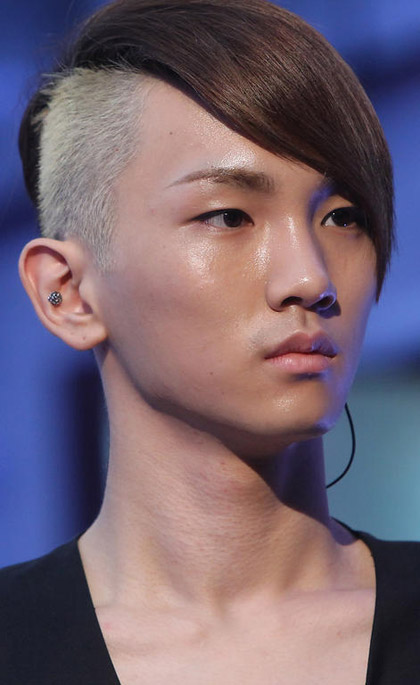
The first article seems a little strange to me. I am tempted to believe it - Korea is doubtless a land of insane department stores, ridiculous commercials, absurd style [As evidence, I cite the following picture of random heartthrob boy celeb with dumb haircut:],
infinite meaningless fashion changes, impossibly annoying cell phones, disgusting celebrity worship, the shallowest, most superficial trendiness imaginable, and two channels of STARCRAFT TV. But there's something fishy: the same survey which gives Korea a score of 69 apparently reports that the Chinese (also 69) are equally materialistic, and that Indians (67) are right behind.
Can that be right?
Consider that Korea's GDP per capita, roughly USD 30,000 per person, is four times that of the average Chinese and ten times that of the average Indian. They may all answer the question "Is money the most important sign of success?" (which is what the survey asked, though there are no specific quo the same way, but does that mean they are equally materialistic? How much of each country's GDP is in excess of what citizens need to scrape by? And how do they use whatever discretionary income they have? Compare the rate of new phone purchases between Koreans and Indians, or the average age of a car on the road, or the last time someone spent a month's income on a designer bag, and I'm sure the resulting gap between the countries will be much larger. When an Indian (not all, of course - the wealth gap there is incredible) thinks of the success money can bring, s/he may well be thinking about having a flushing toilet and maybe even a refrigerator (which will likely be on the fritz due to an underpowered electric grid anyhow). A Korean, on the other hand, will more likely be thinking about a new shiny suit, some front row tickets to a baseball game, or a nice weekend trip to Phuket. Do these two situations display the same amount of materialism?
Of course, though this reasoning disputes some of the less emphasized details of the article, it mostly serves to confirm the headline. But what if we also include the least materialistic countries, like Canada, Western Europe, and the US? (No, no typos here!) Scoring 27, 30ish, and 33 respectively, these noble ascetics apparently know that materialism doesn't lead to happiness. Sure, they earn and spend the most money, depend the most on imports, use the most stuff, generate the most trash, cause the most pollution, drive the biggest and newest cars, expunge the most species, and do their best to hinder meaningful environmental regulation, but they don't think that any of it is particularly important. They don't do it out of a desire for success. They just do it because...that's the way it's done.
Does anyone else detect a big fat load of of cognitive dissonance? If, for the sake of my own happiness, I trash the world, consuming far more than my share and delivering misery unto distant, nameless others in the process, then I am of course a selfish individual. But if I do it not for my own happiness, but for some other reason (are there any?), then it can't really be said that I'm prioritizing my own interests over the health, safety, and well-being of others. In other words, declaring that my happiness and consumption are unrelated ensures my innocence; it makes it possible for me to consume massively, without being a heartless "consumer."
My thesis is that Korea has not yet reached the stage of guilty-richness, the sort of self-conscious recognition of one's own wealth that forces one to evaluate its effect on others.** Despite being one of the richest countries in the world (ranked about 30th by per capita GDP [which I feel is a little silly, since the population is much higher than that of Qatar, Luxembourg, and other top/tiny countries] or 13th by plain GDP) Korea still considers itself to be somewhere in between developing and developed. I'll often hear things like "한국은 아직도 못 사는 나라야" ("Korea is still a country that is barely scraping by), and lots of people expressing jealousy at how nice life must be in the States (and incredulity when I mention that we have our own problems too.)
So: I don't think this survey can really tell us who's more materialistic. What it can tell us, though, is who's more honest.
**This meshes with my (limited) experience with attempted environmentalism here: very little interest in general, and those who are interested, are so primarily because they want to protect the local environment, and not because they care about the welfare of the Chinese or Filipinos or whoever is bearing the brunt of the effects of their consumption.
_______________________________________
The second article doesn't surprise me at all, though the statement that "one in two Korean children and adolescents are dissatisfied [with their lives]" is open to a lot of interpretation. Kids here seem to spend about 8/10 of their waking hours at public school (where they often sleep through lessons, and sometimes get beaten), at after-school academies (where they also sleep and get beaten, but learn things a year or two ahead of the public school curriculum), receiving private lessons at home, doing homework, or at some other sort of school for developing musical or athletic talent. The other 20 percent mostly consists of being shuttled around to and from these various activities, with just enough time in between to grab some street food (all low-quality meat, carbs, grease, and sugar) or a bag of chips and a banana-flavored milk from the convenience store. I used to have fourth graders who were too busy to eat dinner and eighth graders who finished their extra math classes at 1AM.
Not only are the kids busy; they're determined. Of course, they resist studying and look forward to playing as much as they can. But they're also told things like "no matter how hard you try or how smart you are, someone else is trying harder" and encouraged to think test scores as evaluations of self-worth. How else could you get them to accept and internalize the ridiculous demands placed upon them by their parents, teachers, and society at large? I know a twelve year old girl who thinks she's stupid for getting an 88 on her math test (with questions harder than I was doing in middle school), and middle-schoolers who kick themselves for missing just one question on their final English exams (in the "Shit, my life is over" way, not in the the "Argh, I was so close to perfect" kind of way), which are harder than some of the state-level standardized tests I took in high school.
Korean children learn at a young age that, since their country can "hardly scrape by" (again, despite being extremely well off in comparative terms), they need to be in constant competition with their friends and classmates if they are ever to gain entrance into a top middle school, high school, university, or company. Of course, they have friends inside and outside of school, but there is still an omnipresent sort of pressure lurking at every turn.
I am now officially out of thoughts. Rather than pretend to be able to tie it all together, I think I'll just cut it off. Farewell!
"Koreans Most Materialistic People in World"
and
"Korean Kids Unhappiest in OECD"
The first article seems a little strange to me. I am tempted to believe it - Korea is doubtless a land of insane department stores, ridiculous commercials, absurd style [As evidence, I cite the following picture of random heartthrob boy celeb with dumb haircut:],
infinite meaningless fashion changes, impossibly annoying cell phones, disgusting celebrity worship, the shallowest, most superficial trendiness imaginable, and two channels of STARCRAFT TV. But there's something fishy: the same survey which gives Korea a score of 69 apparently reports that the Chinese (also 69) are equally materialistic, and that Indians (67) are right behind.
Can that be right?
Consider that Korea's GDP per capita, roughly USD 30,000 per person, is four times that of the average Chinese and ten times that of the average Indian. They may all answer the question "Is money the most important sign of success?" (which is what the survey asked, though there are no specific quo the same way, but does that mean they are equally materialistic? How much of each country's GDP is in excess of what citizens need to scrape by? And how do they use whatever discretionary income they have? Compare the rate of new phone purchases between Koreans and Indians, or the average age of a car on the road, or the last time someone spent a month's income on a designer bag, and I'm sure the resulting gap between the countries will be much larger. When an Indian (not all, of course - the wealth gap there is incredible) thinks of the success money can bring, s/he may well be thinking about having a flushing toilet and maybe even a refrigerator (which will likely be on the fritz due to an underpowered electric grid anyhow). A Korean, on the other hand, will more likely be thinking about a new shiny suit, some front row tickets to a baseball game, or a nice weekend trip to Phuket. Do these two situations display the same amount of materialism?
Of course, though this reasoning disputes some of the less emphasized details of the article, it mostly serves to confirm the headline. But what if we also include the least materialistic countries, like Canada, Western Europe, and the US? (No, no typos here!) Scoring 27, 30ish, and 33 respectively, these noble ascetics apparently know that materialism doesn't lead to happiness. Sure, they earn and spend the most money, depend the most on imports, use the most stuff, generate the most trash, cause the most pollution, drive the biggest and newest cars, expunge the most species, and do their best to hinder meaningful environmental regulation, but they don't think that any of it is particularly important. They don't do it out of a desire for success. They just do it because...that's the way it's done.
Does anyone else detect a big fat load of of cognitive dissonance? If, for the sake of my own happiness, I trash the world, consuming far more than my share and delivering misery unto distant, nameless others in the process, then I am of course a selfish individual. But if I do it not for my own happiness, but for some other reason (are there any?), then it can't really be said that I'm prioritizing my own interests over the health, safety, and well-being of others. In other words, declaring that my happiness and consumption are unrelated ensures my innocence; it makes it possible for me to consume massively, without being a heartless "consumer."
My thesis is that Korea has not yet reached the stage of guilty-richness, the sort of self-conscious recognition of one's own wealth that forces one to evaluate its effect on others.** Despite being one of the richest countries in the world (ranked about 30th by per capita GDP [which I feel is a little silly, since the population is much higher than that of Qatar, Luxembourg, and other top/tiny countries] or 13th by plain GDP) Korea still considers itself to be somewhere in between developing and developed. I'll often hear things like "한국은 아직도 못 사는 나라야" ("Korea is still a country that is barely scraping by), and lots of people expressing jealousy at how nice life must be in the States (and incredulity when I mention that we have our own problems too.)
So: I don't think this survey can really tell us who's more materialistic. What it can tell us, though, is who's more honest.
**This meshes with my (limited) experience with attempted environmentalism here: very little interest in general, and those who are interested, are so primarily because they want to protect the local environment, and not because they care about the welfare of the Chinese or Filipinos or whoever is bearing the brunt of the effects of their consumption.
_______________________________________
The second article doesn't surprise me at all, though the statement that "one in two Korean children and adolescents are dissatisfied [with their lives]" is open to a lot of interpretation. Kids here seem to spend about 8/10 of their waking hours at public school (where they often sleep through lessons, and sometimes get beaten), at after-school academies (where they also sleep and get beaten, but learn things a year or two ahead of the public school curriculum), receiving private lessons at home, doing homework, or at some other sort of school for developing musical or athletic talent. The other 20 percent mostly consists of being shuttled around to and from these various activities, with just enough time in between to grab some street food (all low-quality meat, carbs, grease, and sugar) or a bag of chips and a banana-flavored milk from the convenience store. I used to have fourth graders who were too busy to eat dinner and eighth graders who finished their extra math classes at 1AM.
Not only are the kids busy; they're determined. Of course, they resist studying and look forward to playing as much as they can. But they're also told things like "no matter how hard you try or how smart you are, someone else is trying harder" and encouraged to think test scores as evaluations of self-worth. How else could you get them to accept and internalize the ridiculous demands placed upon them by their parents, teachers, and society at large? I know a twelve year old girl who thinks she's stupid for getting an 88 on her math test (with questions harder than I was doing in middle school), and middle-schoolers who kick themselves for missing just one question on their final English exams (in the "Shit, my life is over" way, not in the the "Argh, I was so close to perfect" kind of way), which are harder than some of the state-level standardized tests I took in high school.
Korean children learn at a young age that, since their country can "hardly scrape by" (again, despite being extremely well off in comparative terms), they need to be in constant competition with their friends and classmates if they are ever to gain entrance into a top middle school, high school, university, or company. Of course, they have friends inside and outside of school, but there is still an omnipresent sort of pressure lurking at every turn.
I am now officially out of thoughts. Rather than pretend to be able to tie it all together, I think I'll just cut it off. Farewell!
Subscribe to:
Posts (Atom)