Mike Map


View Mike Map in a larger map

Sunday, October 30, 2011

Food Tour Day 1: Breakfast

While some people skip breakfast, others call it the most important meal of the day. Nonetheless, people in both camps have something in common: whether you eat breakfast or not, you probably do so in a hurry. Who, other than housewives and hagwon workers, has time in the morning to actually put together a meal? Picking, choosing, scrubbing, slicing, boiling, frying, and other chores eat up precious time that could be used for more pressing tasks, like finding matching socks and remembering where the #&^( your keys are.

The perceived inconvenience of eating a real breakfast, caused by such maladies as greater distances between home and work, the necessity of dual-income households, and a general lack of interest in culinary independence, has brought us such wonders as Frosted Flakes, Bisquick, and Gogurt. In other words, our pantries have been overrun by corporations. If you can find a single breakfast food in your home that hasn't passed across several state borders and through numerous processing facilities to get to you, count yourself lucky.

It wasn't until my mid-twenties that I developed an interest in eating food without logos, slogans, characters, jingles, boxes, or wrapping. Somehow, even as a graduate of a pretty good university, I still believed that a healthy breakfast consisted of a serving of my cereal of choice (preferably one advertising how many vitamins had been added to it), a cup of pasteurized, homogenized skim milk, a piece of toast, and a bit of meat or an egg, either way, full of antibiotics. Eventually, writers like Michael Pollan furnished me with the intellectual stuff necessary to recognize that I had been wrong all along, but it was life in Korea that gave me the impetus to start making changes. No Waffle House around the corner*, no Tony the Tiger beckoning me from the other end of the aisle, no decent bread, no bacon at all. I was often tempted to just forswear my morning meals altogether, but given that I didn't start work until 3PM, that didn't seem like the best option.

Instead, I took a hint from the people around me. Or, at least, from the ones who weren't neck-deep in Western Food Orthodoxy. They ate rice, beans, nuts, stews, fish, vegetables steamed and raw and fermented - in short, the same basic stuff they ate all the rest of the time. The same flavors, too: where we tend only to have sweet and rich in the AM, Koreans also incorporate salty, sour, bitter, and whatever else you can come up with into their morning meals. Here, there's no giant conceptual gap between food that is to be eaten before the earth has done half its day's rotating and food that is to be eaten after; it would be something close to meaningless for a restaurant to advertise, IHOP-style, that it offers breakfast around the clock.

Adjusting to this new style of eating was a little weird at first, and to be honest, I still hate eating rice in the mornings, but after a short while I found that the barriers were far more psychological than physical. Once you can let go of "tradition" - which isn't actually tradition, because the modern breakfast is almost completely a product of Kelloggs and 20th century food transmogrification technology - you open yourself up to a world of delicious and nutritious possibilities. Even someone as environ-mental as myself, all wrapped up in a quasi-veg*an, anti-corporate, organolocavore lifestyle stuff, living in a strange land far away from home, has plenty to eat.

Here's a typical example. It can be put together in ten minutes, eaten in fifteen, and cleaned in two. More importantly, its nutrition is packaged in whole foods, which means it's more synergistic, more available to the body, and more likely to keep you satisfied until your next meal. I don't know what they eat for breakfast, but my coworkers, most of whom probably eat breakfast later than me and then start class with me at 9AM, often head to Subway (yeah, we have one on campus) for their footlongs right when class gets out at 10:50. My stomach, on the other hand, is hardly even rumbling at 11:40 when the faculty cafeteria opens; I wouldn't go over before 12:30 if it weren't for the mad rush that begins at noon.

Eager to see this magic plate that I've spent the last half-hour talking up? Please, remember that I never said it was much to look at.


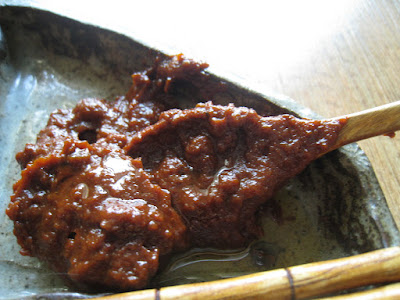
The substance of the meal comes from the sweet potatoes, all nice and chewy; the bite comes from dipping thee crisp carrot sticks and mini peppers into ssamjang (made of soybean paste, red pepper paste, and sesame oil), and the richness comes from pan-fried tofu with a perilla oil and powder sauce. Have a cup of tea first and and, if you're still hungry, a piece of fruit after, and you're good to go.



Fair enough, there's some prep work involved - taking care of the sweet potatoes ahead of time, and, even more, all the embedded labor in the sauces and oils. But who can't squeeze in ten minutes on a Sunday night to prep breakfast for most of the week? And surely the process of making sesame oil is a little simpler than the process of making Smart Start. Further, for those in a real hurry, you could replace the tofu with nuts or a hard-boiled egg. Another benefit of meals like this include that they change throughout the year according to whichever vegetables are fresh, cheap, and in-season. It's easy to replace cucumbers with carrots, to visit the market and buy any of hundreds of varieties of hand-made side dishes, or to incorporate whatever your CSA box happens to bring (quail eggs for me this morning^^). This means that we stay closer to natural rhythms and further from artificial preservatives. Which in turn, means, that we're closer to health, food independence, and sustainability. Sounds like killing ten birds with one stone to me.

Team HappyBear Eats Its Way Through North Jeolla Province

If this post never gets finished, it's because my stomach exploded and I dropped dead with a giant smile on my face.

Like the other members of Team Happy Bear (don't ask about the name), I spent every moment between 5:00 Friday morning and 7:30 Sunday night doing something related to food. You name it, we did it. Shopping. Buying. Harvesting. Killing. Seasoning. Slathering. Cooking. Debating. Discussing. Eating. Enjoying. Thanking. A full month's worth of preparations, tons of plans made and canceled and reworked, all came together for a crazy three-day, two-night bonanaza covering seven meals and several hundred kilometers. I'm too exhausted now to go into the details of what we ate and where, but I'll just say that the trip was a dream come true: me and four foodie friends getting chauffeured around, following traditional Korean food from farm to market to table (to belly), relishing in its simultaneous simplicity and complexity, exploring its endless reworkings of what often looks to the uninitiated like a limited sets of ingredients, and learning about the history, methods, and thought behind it all.

The next ten days will be filled with my attempts to recall, review, and recreate all the experiences that are still whirring about in my mind. Keep checking back - lots of interesting stuff to come!

Wednesday, October 26, 2011

Students say the darndest things

I was doing a little lesson on time yesterday. First, I we went through some pronunciation stuff, in particular differentiating between "thirteen" and "thirty" and the like. Then we played a game where I called out a time and the students had to draw it on a clock on their little mini-white boards (which are, by the way, absolutely the most revolutionary teaching tool I've found for increasing student participation, understanding, and retention). I would tease students (cheerfully) if they drew, for example, 2:50 rather than 2:15, and their teammates would heckle them until they corrected it. Lotsa chuckles.

Then I started working on alternate ways of saying the times. I wrote on the board, "5:00," asked "What time is it?" and got them to say both "It's five o'clock" and just "It's five." Then I drew up "5:15" and elicited "five fifteen" and, after a bit of work, "quarter past five." Next, as you might expect, was "5:30." "Five thirty," most of them say. Then one wiseass, with a big grin on his face:

"Two quarters past five."

Maybe you had to be there? Anyway, it was awesome. Sometimes I love my job.

Wednesday, October 19, 2011

October's CSBS

It's been several months since I was responsible for one of the veg nights. I was supposed to run one in September, but we decided to turn it into a potluck for someone's birthday party, which then got canceled at the last minute, at which point Mina took over and did her usual thing. This week, though, it was all me. And Niall, my Irish coworker/sous chef.

I had no real idea what to make. Having done a few theme meals before, - Indian with Mathan, Italian on my own - I thought about trying to find some other cuisine to work with. Being that we're on a break from school this week (not entirely sure why), I asked one of our Japanese teachers, Yuka, if she'd come help out. She said yes. I asked her what she'd like to prepare, figuring that she would have some awesome Japanese veg dish in mind. She suggested a barley and bean salad. I was a little surprised, but...sure, whatever. As for the other stuff...everyone always requests hummus, I wanted to get back into lentil soup, and I've been making some pad thai-ish stuff with the happy eggs I got from my CSA, so I figured I'd throw that in too.

Nowadays, we usually have about five to seven people at the dinners. Nice and cozy, and fairly easy for the cook. This week, though, was exam week at a lot of colleges and grad schools around, meaning that people had a bit more freedom too shift their schedules around. So, fortunately or not, I was cooking for 12. Have a look:


This picture doesn't exactly show it, but I had to load my panniers, backpack and manpurse to just about the bursting point. Good to know for future biking trips though - with another bag or two, it looks like it probably wouldn't be too hard to carry a supply of simple food for a few days.


2 mile ride to the GCA hangout (i.e. "The Non-Awkward Warehouse")

Item 1: Barley and Bean Salad.


You need: Barley, assorted beans, chives, parsley, garlic, salt, pepper, oil, vinegar
You should: Prep the beans (I used kidney and garbanzos) by soaking the night before, then pressure cook several hours in advance and set aside in a colander so that they regain a bit of their firmness. Cook the barley, rinse it off, chill it a little with possible, then mix together with the beans. The original recipe called for 1/2c barley to 3 cans of beans, which I thought was a little ridiculous. I tripled the barley and doubled the beans. Added in a half cup each of the chives and parsely, though more would've been OK, then mix up the dressing separately and add on. I also had a million sprouts lying around the house, so I dumped them all in. I'm sure you could throw in any leaves you wanted for even more excellence.
The verdict: Awesome. Koreans are often pretty finicky about their rice, and though barley is a traditional crop here, people rarely eat it without mixing it into rice. Also, considering how bean-heavy the salad was, I wasn't sure how everyone would take it. Nonetheless, good reviews all around. Another friend to whom I gave some leftovers told me it was the best thing I had ever made. It takes a little planning, but all-in-all is not that difficult, and is one of those great "toss in anything you have and it'll probably work out ok" recipes.

Item 2: Thai-style lentil soup.


You need: 2c Lentils, 2 cans of tomatoes, 2 cans coconut milk, garlic, ginger, cumin, coriander, turmeric
You should: Cook the lentils for about 25 minutes in one pot while you work on the sauce in another. For the sauce, briefly sauté a bunch of minced garlic and ginger, then, before they get too smoky, add the tomatoes (the recipe called for jalapeños too, but I couldn't get any), stir in the coconut milk, add a bit of each of the Indian spices, and let it simmer for 15 minutes. Once it's all melded nicely, mix it into the lentils and cook them together for another 20 minutes, or just let it simmer til the rest of the meal is ready to go.
The verdict: Everyone seemed to like the dish. The consistency was awesome, and the acidity of the tomatoes and the creaminess of the coconut went together nicely, though it all came out a little bland for my taste. We did drop in more easonings and even a spicy pepper near the end to try to adjust the taste, but it wasn't quite enough. Maybe a bit more ginger in the sauté, even a bit of onion? And a splash of lime juice at the end? Easy enough to make in big batches, and nice and warm and smooth going town, but it needs a little work.

Dish 3: Variation on Pad Thai


I wasn't sure if I was going to need to make the this one or not since I don't have too much experience cooking for twelve. After churning out four big bowls of salad, a giant pot of lentils, and two plates of bread and toast, for some reason, we felt like we'd need more. So we went for it. It turned out to be completely unnecessary, but...

You need: Noodles, bean sprouts, garlic, ginger, onions, tofu, shiitake mushrooms, eggs, oyster sauce, Thai spice mix
You should: Slice the tofu into strips and sauté on its own until it gets a little crispier and chewier, then set aside. Sauté the onions, garlic, ginger and mushrooms, while getting the noodles started on the other burner. Boil the noodles until they've got about five minutes left, then add in the bean sprouts. After five minutes, if you can, remove only the bean sprouts, and mix them in to the sauté. Cook for another minute or two, then toss in the eggs (already beaten) and scramble for a bit, adding in the noodles at the very end. Sprinkle in the oyster sauce - just a little, it might be stronger than you think - and a load of salt and pepper and Thai spice mix.
The verdict: Everyone said they liked it, but personally, I had some reservations. It wasn't quite as good as the stuff I've been making at home recently. The oyster sauce was a little too salty and there wasn't quite enough Thai kick to it. Should've used even more seasonings and crushed up some peanuts as a topping. That said, I love adding bean sprouts in with noodles - it cuts down calories, adds protein, and also slips a little crispness into the noodle mush. Plus, it's easy to get organic bean sprouts and they require much less work to grow and process than noodles do. Anyway, I have a feeling this will become a decent dish after a few more tweaks and iterations. In any case, not too bad for something that started as a way for me to empty out the fridge...


Not pictured: hummus. You probably all know how to make it, but, anyway, here's how I do: (excuse the preceding/ subsequent excesses of colons:)

You need: chickpeas, olive oil, tahini, garlic, onion, salt, pepper, other spices
You should: soak the chickpeas the night before. Pressure cook 'em for about 10 minutes; while that's happening, sauté up some garlic and onions. When the chickpeas are done, strain them, but don't throw out all of the liquid. Blend up the chickpeas, tahini, olive oil, sautéed stuff, salt, pepper, and whatever spices you want (this time I went with chipotle seasoning from home, but cumin and lemon also work well). Add in water and blend until you get it to the desired level of fluffiness. Sprinkle with a little more spice and oil on top.
The verdict: Thankfully, hummus is a novelty here and nobody knows how blase' it is or how hard it is to make one that will actually impress anybody. It always goes over well at the veg nights, though, and I think it's now kind of become expected that I'll bring some. This time, I added in more water to fluff it up and get a little more mileage out of the beans. I still want to move my cooking a lot more towards local ingredients, though. Maybe next time I'll try it with perilla seeds and oil? Or make my own tahini.

Not pictured: toast.

You need: Bread.
You should: Slice. Insert into toaster oven. Plug in. Turn dials. Don't burn.
The verdict: I think I've mastered this one.

Soooo..........


The eaters, clockwise, starting with the peace-sign dude:
Bohemian (nickname), dude I don't know, Ok-bin, Niall, Gyeong-ho, Yong-seong, Bo-mi, Su-jeong, So-yeong. Mi-na is in the back behind the counter, I'm behind the camera, and Il-mi is running late.

Time to chow down^^

Occupy Wall Street here in SK

Some of you may have been wondering whether the OWS stuff has made its way over here. Indeed, it has. I haven't personally read any of the local coverage, but I've been spending a lot of time (i.e. even more than usual) with my Green Consumers Alliance pals, who are up to speed on this stuff. Apparently, somewhere near one thousand people gathered in Seoul last Saturday to show solidarity with the global movement and to air their grievances.

Here in Daegu, a whopping three people (including one of my GCA friends) went to the main park downtown to protest. I considered going, but I've heard that foreigners here can be deported for being present at protests, even peaceful ones. That and I had to clean my house in preparation for a party that evening. In any case, my friend and her friends sat on a blanket and repurposed a delivery box from "Crazy Chicken" to say "Capitalism Gone Frickin' Crazy" (liberally translated), then asked passers-by to write notes, which they collected in the box. They're still deciding what to do with the notes - send them to the government? To Samsung?

I happened to be at the GCA for lunch when a sociology professor from Kyungbook National University stopped by. We had a little chat and I showed her the following set of graphs from MotherJones, saying that they really clarify the meaning of a lot of the numbers that we hear about the top one percent and the bottom ninety and all that. I asked whether any graphics like this were circulating in Korea and she said definitely not, and that she would use them in upcoming classes and lectures. Lookit that, me teaching something to a professional sociologist.

It left me wondering, though, what the income distribution is like here. When a Korean lifts a sign saying "We are the 99%," how much does that say about how much they've been disenfranchised, or how much money has been redistributed regressively? Most Koreans I know are fairly cynical about politics; as I've mentioned before, I've never heard anyone say a good word about the president, nor do I hear much news or discussion about parties or hot issues or campaign stats. It seems like the foregone conclusion is that the rich and powerful will stay that way.

So, I was surprised to see this: a few Koreans at the Seoul protest holding signs that say, left to right, "take over neoliberalism" (not quite sure what that means) and "tax unearned speculation profits heavily," with a comment stating that Korea falls in the bottom third of countries in terms of family income distribution (lower is closer to equal), meaning the top 1% take home about 10% of the income. The number for the States is more like 20 or 30, depending on which metrics you use. I suppose the number seems realistic, considering how few homeless people, ghettos, and slums you see.

Another interesting stat from that page is that the unemployment rate is only 3.2%. That one I have a hard time believing - or rather, the stat is clearly calculated with a funny formula. I say this because, here, university students often put off graduation until they've secured a job. Many people will study for a year or two, then take a year off to go learn English in Australia and another year off to study for the standardized test they'll have to take to enter their field (be it medicine, education, the civil service, etc), and then return to school only once they've passed the test and even lined up an employer a year down the road. There's such a stigma to graduating without having a job already waiting for you that a lot of seniors, if they haven't found a company to hire them, will drop classes during what would have been their final semester and stick around for another. I assume that the official stats count such individuals as students, and not as people who want work but can't get it.

No particular conclusions or thrust to this post...just a bit of stuff on my mind. It occurs to me that maybe I ought to leave my money in the banks here rather than in the US though.