Mike Map


View Mike Map in a larger map
Showing posts with label 맛난 Masticatables. Show all posts

Wednesday, November 23, 2011

November's CSBS

Apologies for the delay - with the help of my good buddy Niall, I cheffed for the Green Consumers' Network Earth-friendly Veg Night two Tuesdays ago, but I left my camera there at my friend's house and didn't get it back until the subsequent meal. Blogging about the 1KFTFFF has also kept me quite busy, as you may have noticed.

Last time, I was feeling a little guilty about my veg night offerings. Everyone liked everything, but the last-minute canned tomatoes and well-traveled chick peas and coconut milk made me a bit uncomfortable. Plus, I kind of slipped up and used some (decent) eggs from my CSA in the Pad not-quite-Thai, forgetting that just because I'm not as vegan as I once was doesn't mean that I don't have to follow CSBS protocol. Thus, this time, I resolved to shift ever closer to local and seasonal ingredients.

Sometime until about November 10th, everyone was talking about "Indian Summers" and wondering when the cold would hit. Then, it did, so Niall and I opted for something warm and hearty. We also wanted to keep it simple, given that it was a school night. Here's what we came up with:


The usual hummus recipe (yeah, I know, not local, but it was a special request and appears to have become tradition), this time with some spinach blended in. The taste didn't change much, but the color was nice, and it was probably a bit healthier. Served with sliced bread, carrots, celery, cucumbers, and bell peppers.


Niall's carrot/ginger stew. Stir-fry a bit of onions and garlic, then add in a bunch of carrots, ginger, water, and maybe a sweet potato or two to increase the creamy factor. Simmer for a while then blend it up and season with salt and pepper. Nice and warm, goes down easy, and has a nice kind of kick. Almost certainly good against the cold. And...uh...VERY easy to digest, yaknowwhattImean?


(one benefit of cooking soup: napping opportunities)


My lentil soup: admittedly not the prettiest thing I've ever cooked up, but definitely among the most delicious. Again, sauté some onions and garlic, add in some potatoes, carrot, and celery, fry for another minute or two, then add in a bunch of lentils and slightly more water than is necessary to cover them. Drop in a few cubes of your favorite vegan bullion (or use stock to start with) and cook for 30 or so minutes, checking every now and again to make sure the water hasn't boiled off. When pulled off correctly, the potatoes absorb the broth and turn out all creamy and delicious, nicely balancing against the heavy graininess of the beans. Squeeze a little lemon juice into the soup for some extra awesomeness and you're good to go.

And...that's all!


Astute enough to notice the unusual decor? This time, rather than dining at our usual headquarters (known as the "Un-awkward Warehouse"), we gathered at friend and dependable member Bohemian's house in order to warm it. After the nice meal, we hung out and I taught everyone a card game ("Oh Hell") that I learned this summer staying with my family out west. Ever tried explaining the rules to a card game in a foreign language? When there are people who don't know the difference between Ace, King, Queen, and Jack present? It's a chore, but once you've mucked through it, very satisfying in that hey-we-all-share-the-basic-elements-of-humanity way.

In any case, Bohemian, congratulations on the new place and the completion of all repairs.^^

Oh, and happy Thanksgiving, everyone. I thank you for reading and caring about me even though I'm so far away. There's a song lyric that has been more meaningful to me for the last five years than just about any other, and now seems like a decent time to share it:

"I do not exist," we faithfully insist,
Sailing in our separate ships and from each tiny caravel.
Tiring of trying, there's a necessary dying,
Like the horseshoe crab in its proper season sheds its shell.
Such distance from our friends,
Like a scratch across the lens,
Made everything look wrong from anywhere we stood.
And our paper blew away before we'd left the bay.
So half-blind, we wrote these songs on sheets of salty wood.

(MewithoutYou, "Messes of Men")

Hope all is well with everyone!

Friday, November 18, 2011

Team Happy Bear Cooks: Mike's Garlic Shoots

As the point of the whole 1KFTFFF was to help Hansik popularize Korean food, we Happy Bears figured that we ought to supplement our packed eating schedule with a bit of cooking, too. After all, though everyone deserves to be introduced to all the wonders of Korean cuisine, not everybody is fortunate to live close to a Korean restaurant. While we can't deliver to everyone in the world, the least we can do is spread the word.

Andy and Anina have both already posted about their contributions: Gosari (Fern Bracken) and Yeongeun (Lotus Root).


I myself contributed two dishes, both of them quite easy.

First off, a very simple salad I learned from my friend Mina, the chef of the weekly "Vegetarian Dinner for the Earth" at my local branch of the Green Consumers Network. Just take a sweet cabbage (단배추, pretty similar to a Napa) and chop it up into chopstick-friendly chunks. Then, make a sauce of perilla oil, perilla seed powder, and salt. Once you've matched the proportions to your preferences, pour the dressing onto the leaves, then mix with your hands, squeezing everything with just enough pressure that the sauce evenly coats and permeates the cabbage, but not so hard that you crush them into a mush. The result: a rich, oily, and yet light salad that fits right in with the sweet, salty, and pungent side dishes around it. Unfortunately, my coworkers were busy cooking and my hands were busy squishing, so I didn't get any pictures of this one.

Second, another one of my favorites: sautéed garlic stems (마늘쫑 볶음). These were complete news to me the first time I tried them, but I immediately fell for their savory simplicity. To get started, chop the stems up into pieces about 1.5 inches long; again, just right to be picked up with chopsticks. Fill a frying pan with just enough water to cover them, then boil for about two or three minutes, just to soften them up. Move them over to a colander, drain out the water, and heat up a bit of sesame oil. One it's warm, drop in the garlic stems, and, if you are a big garlic fan, slice up a few bulbs and drop those in as well. Lightly brown the outsides of the stems, and before they get too droopy, pour in a bit of soy sauce. If you've got a sweet tooth, now's the time to add the sugar. Either way, once the liquid has mostly cooked off, remove the stems from the pan and sprinkle them with sesame seeds - for extra punch, crush them as you sprinkle, as this will release more flavors, in addition to making it easier for your stomach to absorb all the goodness.

That's all! Serve with rice, soup, and other side dishes for a splendid meal.


Garlic stems pre-sauté


The finished product

Also present:


Seasoned bellflower/balloonflower root (도라지 무침)


Don't recall exactly, but this looks to me like 시금치나물 (blanched spinach with garlic and sesame oil)


A bit of fresh fruit. We were lucky to find local figs in the market the previous afternoon.


All the side dishes in one shot! Those are Tanya's tiny little sweet-n-spicyy anchovies in the top-left, a mayo/sunchoke/carrot/cuke salad at top-center, and my cabbage and perilla salad at top-right.


The spread, including Greg's spicy oyster and mushroom soup!


We were truly happy to be able to share our food with one another and with the translator, driver, and TV crew who worked so hard to make our food tour possible. Thanks, Hansik and KBS^^

Thursday, November 17, 2011

Old School Tofu

This may not sound very cosmopolitan of me, but all the way into my early-mid twenties, I was pretty scared of tofu. I harbored an apprehension that I still can't elaborate on, one which I can only excuse by incriminating myself further: I was also scared of oranges until I was about eighteen, hash browns and refried beans until twenty, and eggs and tomatoes until twenty-two. If you doubt me, get in touch with my college roommates. I'm sure they'd be happy to confirm.

Living in a foreign land, one learns to get over such childish fears, partially because it'd be a waste of time to be abroad without sampling the local cuisine, and partially because you have to get pretty good at a foreign language before you can really be picky when ordering. Korea is particularly good for expanding culinary horizons, because no matter what you order, you're likely to wind up with a smörgåsbord of vegetable-and-other side dishes you didn't exactly ask for, most of them so unfamiliar that you won't have had the chance to form any prejudices about them. Most days, I thank Korea for having helped me learn to eat outside the box, so to speak.

Back to topic: I eat tofu so frequently now that I can't imagine there was a time when I refused to eat it at all. It's not that I really love the stuff - actually, I have some apprehensions about it, having read that overconsumption can lead to hormone imbalance, that the soybeans are often GMO, and that it's not safe for humans to depend so greatly on a single plant. Nonetheless, it's everywhere and just about unavoidable, and considering that people have been eating it for hundreds if not thousands of years, it's almost certainly safe when eaten in moderation as part of a balanced died. I had it on its own with just a little spicy sauce as a side dish for Makkeoli (rice wine) last night; the previous weekend, I had it sprinkled with sesame seeds and served with roasted laver and stir-fried kimchi as a compliment to some noodles; it's in just about every vegetarian soup that doesn't contain seaweed; and when it comes in my CSA every month, I turn it into croûtons or just lightly sear it at breakfast time.

After all these years of eating tofu without quite knowing what it was , I was happy to get the chance to participate in the process of making it at Joseon Village. After waking up early, having a light breakfast of fruit, and wandering around a bit getting a feel for the place - as I detailed in a different piece, "Applied Food Ethics at Joseon Village," we happened upon a lady sitting in a hot, smoky, not-quite-indoor-not-quite-outdoor kicthen. She was perching over a giant cooking cauldron which had been excellently designed to be fully integrated into the building's heating system so that not a single ounce of wood would be wasted. She was swooshing around a frothy, white liquid, made by grinding soy beans that had been soaked over night and then adding them to water. They need to be boiled to be cooked thoroughly, and need to be stirred lest they burn to the bottom of the pan. Greg offered to jump in and take a turn.


Greg hard at work.

After boiling the beans and stirring them continuously for the better part of an hour, taking breaks whenever our eyes welled up with tears from the smoke, it was time for the next step: separating the ground beans from the liquid that had absorbed much of their taste and nutrients. I took a giant cloth bag perforated with tiny holes and held it open while the woman scooped out the contents of the cauldron. The sediment remained in the bag, while the liquid escaped through the holes and down into our pot. At the end, I lifted up the sediment-filled bag, and we poured the thinner liquid into a giant rubber tub.


We then sat a big wooden press on top of the tub, plopped the bag of sediment on top of it, and squeezed out all the remaining liquid, leaving us with one tub of very dry grit and one bucket of very beany juice.


Another kitchen worker skimmed some of the liquid off of the top, sugared it, and served us all bowls of fresh, warm, sweet soy milk right on the spot.


Our translator, Ziyeon, with the goods.

After we allowed the same stuff in the red bucket to settle for a while, it turned into this:


Sundubu (순두부), a thin kind of tofu often added to soups. More or less like Silken stuff back home, I believe.

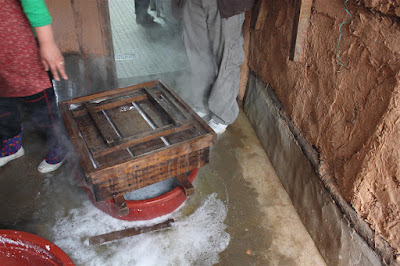
Then, to turn it into the stuff we're used to - the the stuff that come in cubes and holds its shape more or less like Jello - we used this little contraption.


Everything is again poured into a bag, which is itself set inside a little wooden box. The box is closed, a weight is set on top, and left for a few hours. All the liquid drains out (it didn't occur to me to ask what they do with this) and the weight and frame mold the tofu into its eventual form.


Fortunately or unfortunately, we didn't have an hour to wait around. We headed right off to visit some perilla plants (separate post here) and some chickens (and here), all of which we ended up eating (parts of).

In case you're wondering what happens to the grit, worry not: on a conscientious farm, none of it goes to waste. There's a soup called 콩비지찌개 (Kongbiji Jjigae / Bean Grit Stew) that combines the grit with fermented soybean paste, chilli peppers, and a few other vegetables. The grit can also be used to make awesome kimchi pancakes, slightly thicker and more filling than ones made with flour. Or, it can be fed to animals or returned to the land as fertilizer.

All beautiful options. Though, of course, you can also just eat it straight:


Tanya enjoys getting fed by I don't know whom!

Wednesday, November 16, 2011

Perilla: A Korean Treasure

It's nearly impossible to me to pick my favorite Korean food. So many different kinds exist, covering an expansive range of tastes, smells, textures, and cooking methods. Plus, since just about everything you order is served with several side dishes, you almost never eat just one kind of food in isolation. However, if pressed (slight pun alert!), there might just be one food I love more than the others. I appreciate its fecundity, admire its versatility, savor its scent, and might be happy eating it in some form at every meal for the rest of my life. Had I been more eloquent as an elementary schooler, I might have spoken this way about Pizza Combos. Now that I've matured a bit, though, I prefer Perilla.

Although foreigners and dictionaries here often refer to Perilla leaves as Sesame leaves (the Korean name, 들깨, is pronounced Deul Kkae, which literally means "wild/field Sesame), Perilla is not in fact all that closely related to the Sesame plant . Rather, it belong to the mint family - a fact to which its extremely fantastic smell testifies. Once, while volunteering on a Korean farm in the dead of winter, I was asked to help the farmer round up some leftover stalks and weeds from last year's harvest. I expected the long-dead, decomposing material to reek of decay (which is, if you care to get philosophical about it, just the smell of another form of life), but as I raked the stems and leaves into piles, I found myself surrounded by an aroma familiar but fuller and richer than what I remembered, tinged with just a bit of spice. I wasn't sure whether I wanted to eat the source, or bathe myself in it.

The plant in question was, of course, Perilla, also known in English as "Beefsteak" for no apparent reason. I love Perilla so much that, when I first decided to sign up for the tour, before the details of the trip were all filled in for us, I was hatching plans to drag my team to a Perilla farm for the whole time, so that I could learn everything there is to know about the plant. How do you grow it, and when? How does it produce so many seeds, and out of which orifices? How hard is it to harvest them and turn them the products you find on store shelves? If I walk through a field of Perilla, might I pass out and wake up thinking I've made it to heaven? Is it possible to die of olfactory satisfaction?

Those plans didn't work out (actually a pretty fortunate turn of events, considering how awesome the rest of our food tour was), so you can imagine my joy when we stumbled upon a worker at Joseon Village hanging out next to a big pile of what looked from afar like nondescript sticks.


If you could smell it, you'd already know, but since Google hasn't added that service to blogs yet, I'll zoom in and show you: here lies treasure.


These are the stalks of the almighty Beefsteak plant. It had originally looked like this,


but the leaves had already been harvested, to either be eaten raw along with meat, rice, and garlic, to be made into kimchi, or to be battered and pancake-ified. (I also use them in lieu of basil when making my own Korean version of pesto.) As if that weren't enough, though, the plant has more to give: inside each little pod rests a seed, a little pocket of nutrition and deliciousness. Each Happy Bear made an attempt to master the patented ultra high-tech Joseon Dynasty Perilla Extraction Method, i.e., grab a handful of branches, set a little basket under them, and thwack 'em with a stick. The seeds and pods drop off into the basket, as shown below. Then you do a bit of sifting to get rid of the inedibles, and, voila, you've got what you were after.


What can you do with these seeds? It'd be better to ask what you can't do with them. First of all, if you're famished or greedy, you can eat them straight. The seeds don't have all the savory herbiness that you find in the leaves; rather, they're rich and creamy and smooth. One of our team members - Andy, I believe, who was having his first taste of pure Perilla - commented that they tasted like walnuts; at which point Tanya's face lit up. Due to her nut allergy, she had never been able to taste walnuts and had long wondered what they were like. All of a sudden, she had run into their approximation in the form of a long-lost Korean step-cousin.


I'm trying to smile, but my mouth is full of seeds. This must be a what a bear feels like when it at long last gets into a beehive.

If you've got a little more patience, you can grind them into a powder or press them into an oil. The powder is often added in small to seaweed or soybean paste soups to give them a bit of hearty sweetness and to counterbalance any salt; or, it can be used as the main component of a noodle broth, as in the fantastic-if-under-known-about 들깨칼국수 (Deulkkae Kalguksu):


I hope you'll pardon a slight digression on how great this dish is, particularly for veg*ans such as myself. Imagine: a giant bowl of thick, formidably chewy noodles, in a sauce that reminds you of Alfredo, only slightly thinner and minus the greasiness, indigestion, and regret. Steamy, creamy, and oh-so-filling, the broth is made by adding powdered perilla seeds into a savory stock (most restaurants include meat in the broth, but all you need to make a purely vegan version at home is a bit of vegetable boullion); the perilla seeds are packed full of good stuff like plant protein, omega-3 fatty acids, vitamin A and E, and dietary fiber, all of which are important nutrients to have in your diet, vegetarian or not.

And there's more: crushed and powdered seeds (들깨가루, Deulkkae Garu) are also used to make a creamy topping for various side dishes, most notably fern bracken and lightly pan-fried tofu. Speaking of which, when pressed, the seeds release an oil (들기름, Deul Gireum), which is exceptionally useful when stir-frying at low temperatures and a represents a great domestic alternative to olive, canola, and other oils imported from afar. There's also one more awesome recipe I'm looking forward to telling you about, but it's kind of top-secret, so you'll have to wait for my post about the meal that my teammates and I put together for our final day's breakfast.

If you're interested in incoporating some Perilla into your diet, you shouldn't have too much trouble. You can find perilla-broth noodles many noodle shops, particularly now that the summer is over and iced bean-broth noodles (콩국수) are off the menus. Grain/bean/seed stalls at traditional markets usually have the seeds by the bucketful, and the oil and powder are available at most local/organic/health food shops as well as, of course, at the megastores. Ah, and one more thing: Deulkkae is traditionally known in Korea for helping people fight off colds and sore throats. Go find yourself a source before the winter sets in!

Tuesday, November 08, 2011

Why Kimchi Is Good for the Soul

I never gave much thought to kimchi before I moved to Korea. Just miles from my house, there were loads of Korean restaurants and Asian supermarkets where, unbeknownst to me, thousands of foodies (did they exist in the 90's?) and Korean expats must have been getting their fix. Personally, though, if it couldn't be cooked in the microwave or toaster oven, I just wasn't interested.

How strange then that, now, I see so many fantastic things about kimchi, and almost, if resentfully, have to nod my head when Koreans say that it just might be the perfect food. First of all, it's just great to eat. Spicy like salsa, crisp like an apple, sour like movie theater candy - no matter what you're eating, something about kimchi will compliment it. Second, it's versatile. Eat it raw, eat it stir-fried, drop it in a stew, make pancakes out of it, slap it on your burger or pizza. Third, it's healthy. Made (in its most basic incarnation) with cabbage, salt, red pepper paste or flakes, and a bit of shrimp or anchovies, it's got nutrients a-plenty and calories a-few. The fermentation process loads it up with all sorts of little bacteria that provide your body with nutrients that you might not get in a diet of exclusively raw, cooked, or processed foods. Fourth, it lasts. Whether you make it yourself or buy it elsewhere, you can keep it refrigerated for up six months in an air-tight container. It may grow sour, but it would require some serious neglect for it to grow inedible. Fifth - and this is a somewhat subtler point - cabbage can live in the ground long into the winter, even surviving when the temperatures drop below freezing, which means that it thrives long after sweet potatoes, pumpkins, and carrots have given up the ghost. Over the centuries, during the months of December, January, February, and even March, when there wasn't really a lot of stuff to harvest, cabbage and Kimchi probably saved a great number of Koreans from starvation. Now, we're more likely to think in terms of food independence, but either way, it's unarguably a good thing to have some grub growing nearby.

So, what would a Korean food tour be without some time spent immersing oneself in cabbagey glory? As I detailed in my last post, Lee Hee-cheon of White Crane Farm was kind enough to let us swipe a few of his cabbages (even though technically they were just babies whose time hadn't quite come), which we then took down to the restaurant run by his wife, Park Yang-yoon. Mrs. Park is a fantastic cook: as interested in her husband in providing clean, safe, healthy food, but probably a bit more talented when it comes to making it scrumptious.

Thanks to a giant bibimbap spread earlier in the afternoon and some raw carrots and garlic just before at the farm, we Happy Bears needed to work up a bit of an appetite before we could begin chowing down. So, Mrs. Park set us up with a table outside the restaurant and gave us a crash course in making kimchi. The photo record is somewhat incomplete, since all of us were busy washing and chopping and slathering, but here's the gist:


1) Chop the butt off of the cabbage and remove the outer leaves, which were the most exposed to dirt and bugs. These leaves can be cooked and eaten in sides and stews, but apparently don't make great kimchi.

2) Then cut the whole head in half along the vertical axis. Make another cut like you're going to quarter it, still along the vertical axis, but stop about 2/3 of the way down. This allows you to open up the cabbage for the next step, without completely disassembling it.


Andy and Anina work on Step 1 while me, Greg, and Tanya work on 2.

3) Rinse the not-quite-quartered heads thoroughly, then rub salt on each and every leaf. This kills bacteria and opens up the pores, allowing the spices to soak in later.


Andy's a'washin', Tanya's a'saltin'


4) Stack all the wet, salted cabbage halves and then apply pressure by leaving a heavy rock or pot on top of them. I guess it takes some time for the salt to do its work.

5) Prepare the sauce. Normally, red pepper paste, ginger, garlic, shrimp, and anchovies, but we also chopped up some other veggies for extra goodness.


Knife skill contest time.


6) Don your plastic gloves, let you burn off your fingers. Lie the cabbage on its back (with the outermost leave touching the plate) and lift up all but the last leaf. Rub some sauce on it, and also on the back of the leaf above it. Let the next one down and repeat, making sure to slather a bit of spice on the front and back of every leaf.


This stuff was still in the ground, alive and growing, less than 2 hours beforehand!

7) It's ready to eat! Or, you can wait a few days/weeks/months.

As if the act of eating weren't reward enough, there's one more thing I'd like to point out about kimchi. The actual process of making it was also a blast! I knew two of my team members going into the project, but I had never even exchanged emails with the other two, let alone met them. We were all friendly, but, personally, I didn't quite know what to talk to them about while we were listening to the farmer and chopping our own cabbage heads off. But, when we joined together to make Kimchi, we really hit it off. All being involved in learning something together and, even more, sharing knowledge and hints and tips while working towards a common goal, gave us a comfortable atmosphere in which to get to know one another. When you're on opposite sides of the table preparing kimchi with someone, there's no need to ask awkward questions and try to figure out what you've got in common. You're already there, together, doing the same thing. It's all right in front of your eyes. The bond is more instant, and more tangible, than any "me too." It's much easier to come together over production than consumption.

I'm sure everyone else has good, if not quite this exotic or preposterous, memories of this sort. Cooking with parents in the kitchen, with the extended family over the holidays, with roomies in college, or out at some backyard barbeque. Whatever the specifics, just hanging around food with other people is one of the simplest and most satisfying pleasure life affords us. This is also one of the pleasures that we risk losing as we outsource our cooking to restaurants and corporations, leaving independence, tradition, and solidarity by the wayside. I feel lucky to have had the chance to realize this. And also to eat (some of) the following:


Tofu, fresh kimchi, and steamed pork


From 12 o'clock, going clockwise: candied lotus roots, cucumber pickled in soy sauce, radish leaf kimchi (I believe), old/sour cabbage kimchi, sauerkraut (first I'd ever seen in Korea), fern bracken with perilla dressing, and, in the middle, pickeld garlic.


Time to eat!


Translator, foodie, foodie, chef, farmer, foodie, foodie, foodie

Wednesday, November 02, 2011

Team Happy Bear Goes Organic

At Hangukjib, my teammates and I got a chance to put our own meal together. Not all the way from beginning to end, since so many of the vegetables had already been sautéed for us, but, in any case, more than usual. By learning about the people, history, and techniques that lay behind it, we had deepened our relationship with our food, and had been reminded once again that everything we eat can be appreciated in various ways. We can enjoy the taste, of course, and get lost in the sheer beauty of the dish, but we can also develop respect for and gratitude towards the people who put it together. We can note our sense of nourishment and satisfaction after the meal has been completed. Last, but not least, even as foreigners we can feel ourselves embedded in hundreds of years of history. Bibimbap was formerly eaten in various incarnations by peasants, by kings, by the bereaved. Now it's being eaten by people like us. The world is indeed a strange place.

Even such a deep experience, though, fails to address what is for me the most important question: what was the effect of my meal on the earth and all the other beings on it? Did it do more good than harm? Are the practices that brought it about sustainable? Are my choices contributing to others' ability to eat well, or am I detracting from it? Of course I want my food to bring happiness and wellbeing to me; but if it does so at the cost of sickness, deprivation, or destruction for others, I'd prefer to opt out.

Luckily, we're not caught up in some zero-sum game in which our health necessarily results in other's misery. It is possible for eating to benefit the earth and everybody on it. Or, more accurately, it's possible for farming to. Good farming, on a small scale, done with care, attention, knowledge, respect, and patience, can rehabilitate land, recover topsoil, recreate space for animals to graze on, and restore health to people. Team Happy Bear wanted to see this kind of work up close, in context, and in action, so Hansik graciously offered to take us out of Jeongju and into Jeong-eup to meet Lee Hee-cheon.


Meeting Farmer Lee

Farmer Lee started 백학농원 (White Crane Farm) some-teen years ago (that's a direct quote, not my memory faltering) because he wanted to feed his family food that was healthy and safe. I asked him if he had done conventional farming before switching over to organic, to which he replied, more or less "I would never farm anything except organic. What's the point?" Here's a dude who understands what it's all about! Non-organic farming methods, in the long run, create and exacerbate a host of seemingly disconnected problems, from oil depletion to water pollution, from topsoil loss to political instability, from starvation to obesity. Organic, sustainable agriculture is the only foundation upon which we'll be able to build strong, healthy, enduring communities in the future. If I were more of a historian, I might also try to make a similar claim about the past. In any case, Farmer Lee said that he had been successful: his kids are healthy and energetic, and his land is becoming more fertile year after year.

It would take a full year on an organic farm to really begin understanding anything, but, unfortunately, we only had a few hours together with Mr. Lee, so we quickly got down to business in the cabbage patch. He explained that he doesn't use any chemical pesticides or fertilizers. Instead, to control bugs, he creeps through his fields, searches for clues like eaten-up leaves and little insect droppings, spots the invaders, and plucks them out with a pair of chopsticks. It does sound like a lot of work, but actually, it's not particularly harmful to eat a leaf that bugs have already nibbled on. In fact, Mr. Lee says, the fact that bugs eat it means it's probably good enough for us, too. Would you want to eat something that even a roach wouldn't go near?


This is neither here nor there, but it was at about this point that Mr. Lee picked a grub off of a piece of cabbage and said that it was probably pretty healthy, since it had been feasting on organic food. Greg then took the grub and scarfed it, more or less blowing the farmer's mind. Apparently he hadn't been given the full dossier on Team HappyBear!


Andy hoists a cabbage-trophy. In less than 4 hours, it will be Kimchi...

After harvesting some cabbages together, we walked down the hill, flanked on either side by persimmon trees just about ready to lose their leaves to the autumn and their fruits to hungry tourists. We moved on to the next stop: the carrot and garlic patch. The five of us all planted garlic together by pushing cloves about an inch into the dirt then covering them back up, while Mr. Lee explained that, as deplorable as the plastic (they call it "vinyl mulch" here) is, it helps the plants a lot by retaining moisture and warmth and keeping out weeds, which essentially steal nutrition from the garlic, keeping it from growing as big as it might. It's still not clear to me whether this kind of farming can really be called "organic" in the fullest sense of the word, but it's a whole lot better than the alternative.


Working up an appetite / earning our keep


Me and Tanya after eating a fresh clove of garlic each, wishing the cameras were equipped with smell-o-vision technology.

After planting garlic, we dug up some carrots, scrubbed them off on our pants, and, much to the amazement of Farmer Lee and the Hanisk crew, chowed down on the spot. Some were a little concerned about the dirt, but we told them: not only is organic produce healthy; so is the soil it's grown in. After all, all the vitamins and minerals in fruits and veggies come from one of two places: the soil, or chemical reactions within the plant. (Botanist friends: correct me if I'm wrong here). Our smiles and "mmmmms" probably did more than our arguments to overcome the crew's skepticism, but either way, they joined us, munching on the freshest and healthiest carrots they'd probably ever had. Unfortunately, I was too busy eating to take any pictures.

Tuesday, November 01, 2011

The Hungry Vagabond Gets Treated Like a King

Whenever I tell Koreans that I'm a veg*an, they generally ask the same question: what do you eat? Most of them don't seem to realize that Korean cuisine is full of awesome vegetarian goodies: pancakes made with green onions, chives, kimchi, potatoes, or lentils; noodles hot, cold, creamy, or spicy; all kinds of soups porridges; tofu in various guises. Then, of course, there's also 정식, or Jeongsik, or Table d'hôte, or the "set meal." No matter what you call it, it means rice, soup, and anywhere from, say, five to thirty-five side dishes, almost all of them veg-friendly.

However, the king of Korean vegetarian fare is, without question, Bibimbap (literally, mixed rice). Normally, I wouldn't take it upon myself to write about it, given that it's probably the simplest, most well-known, and most widely-diffused Korean food out there, with the possible exception of LA Kalbi. Thanks to Hansik, though, I recently underwent the most extreme and regal Bibimbap experience of my life:


Bibimbap with a master. This Granny (a term of respect in Korean) has been making Bibimbap for 52 years and claims that her mother invented it, or at least the high-class version.

Your standard Bibimbap - even the one I ate on the airplane on the way over here nearly five years ago, which, incidentally, was the first Korean food I ever tried - is vegetable heaven. Julienned vegetables like sauteed radish, carrot, and bracken, along with steamed and seasoned spinach, some bean sprouts, and a bit of roasted seaweed sit atop a bed of rice. Throw an egg on top if you'd like, drop on a dollop of red pepper paste, and stir it all up. Voila: a natural, low-maintenance, delicious vegetarian meal. At a cheap restaurant, this will run you about 3 dollars; at a fancy one, closer to 6.

For Kings, or, in this case, a bunch of vagabond foodies, Bibimbap can really be scaled up. Check out our table above: everything I just mentioned, plus sweet and spicy balloon flower root (it's OK if you have no clue what this is), sauteed zucchini, sautéed shiitake mushrooms, thin-sliced egg, mung bean jelly, ginko nuts, pine nuts, crushed sesame seeds, and a special broth made right there at the restaurant.


Some of the high-class toppings


Listening attentively to half a century of wisdom.


Being that everything will eventually get all stirred together, you'd think you could just throw in all the ingredients any which way. It's not so, though! The master insisted that we put each ingredient in its own place, paying particular attention to color symmetry. White radish slices and bean sprouts should be on opposite sides for optimal aesthetic appeal; sauces and nuts at the end to give it that just-completed look.


Me, Greg, and Tanya enjoying the lesson. Unfortunately (for them) Andy and Anina had not yet joined the festivities.


Can you believe I made that?

It turns out that even mixing it requires a particular technique. In addition to stirring everything up and mixing it evenly, one has to be sure to smush it together just so, in order that the perfect balance of soy sauce, sesame oil, and pepper paste will be mashed in to each grain of rice.


I got a little help from the boss on this one. Oh my god was it good.

It turns out, then, that Bibimbap has a fairly unique quality: no matter who puts the dish together for you, the final result is the outcome of your own skill. Even if you go all the way to Jeonju, search out the "Hangukjib," (the name of this restaurant) and order the most deluxe bibimbap on the menu, it's up to you to make it or break it! I see a little something symbolic in this: money can't buy you the best bibimbap; only familiarity can. Good food calls for good cooks, but also for good eaters, eaters who know something about the story and the theory of their food. Eating is consumptive, of course, but at its best, it's also participatory. More than many other places I've been, Koreans seem to be intent on holding on to this respectful, if not quite reciprocal, relationship between eater and eaten. Not as much as they should, given how many treasures their cuisine contains, but enough that just living and eating here as made me aware that people can, in fact, approach their food in different ways, some better than others. I owe many thanks to this Grandma in particular, and to others like her all around the country, for helping me learn how to really enjoy and appreciate food. Now, go get a bowl for yourself.


Me, Tanya, and Greg with two generations of Bibimbap Matriarchs.