Mike Map


View Mike Map in a larger map

Tuesday, April 26, 2011

As if I needed more proof that I'm not as smart as I like to think I am.

Here's a little drawing of my bathroom.


The black up top is a ceramic counter that runs along the back wall; the dark blue ball is the sink; the brown blob is the toilet; the red block is the door; and the light blue ball is where the tap and shower head are installed.

As is typical of Korean bathrooms, there's nowhere to put a little cloth mat, since there's no real distinction between places that should be wet and places that shouldn't. It takes a certain amount of skill to ensure that you don't soak the TP (mounted on the wall between the door and the loo) and your appliances when you shower. The problem is by no means insurmountable, and is even accompanied by certain benefits (no worries about dripping in the ought-to-be-dry zones, no sudden freezing after opening the shower curtain, no stinky, moldy bath mats). However some foreigners prefer to try to restore some order to the bathroom by hanging up a curtain. When doing so, you've got two choices.

In a bathroom like mine, the short-axis curtain allows the toilet to be used when someone else is in the shower:


On the other hand, the long axis curtain keeps water away from the sink and toilet, reducing griming and eliminating the need to wipe things down quite so often:


I originally had the former setup, but due to an inebriated bathroom scuffle in the aftermath of the Idli Party, the curtain came down and was sloppily reinstated in the lower manner. At first I thought it a little ridiculous, but I soon came to appreciate it. In addition to the cleanliness benefits, it prevents you from having to stare at yourself in the mirror for the duration of your shower-and-dry-off time every morning.*

The downside is, it cuts your showering space about in half. For the last 3 months, I've been showering with my back scraping up on the plastic sheet, or getting sprayed directly in the face, or standing up on my tippy-toes to get a nice full blast to the armpits**.


If you nodded your head just then, well, sorry to say it, but you are a nincompoop! I don't know how it has possibly escaped me until now, but there's a solution to this problem that's free, instantaneous, easy, low-tech (actually, no-additional-tech), and completely obvious. Can you think of it?


?


?


?


?


The answer is:


Turn the shower head and take a step sideways!


Look how brilliantly the hypotenutal shower stance solves all your morning hygiene problems! Each inch you move to the side provides you with (CHALLENGE: PROVIDE ME WITH THIS NUMBER, OR AT LEAST THE FORMULA) X inches of extra space in which to shower. I am pretty sure that there's an exponent in the works, so it's a good deal!

According to my calculations, this post is about 98% random and worthless, but the remaining 2% reveals something interesting. I think it actually demonstrates how deeply we can become stuck in certain patterns of thought, how much we accept certain things as given, even when the solution lies right in front of our eyes (or beside to our dripping posteriors). Whence the assumption, despite overwhelming evidence, that the 90 degree angle, perfectly perpendicular to the wall, was the best one? I must have take the shower head out of its socked and returned it there at least four or five times a day for three months, and yet it never even occurred to me that less symmetry might do me some good. What was it that prevented me from even considering stepping out of line?

How often do we put up with little, slightly annoying things just because we think that either there's no solution or that it's out of reach? How often is our ability to think of solutions cut off by our assumption that there's some weight behind or reason or justification for the status quo?

It may be a stretch, but it seems to me like there's a parallel here between these tiny little inconveniences that we could easily deal with, but don't, and larger social wrongs that we could also play a part in righting, if only we weren't so used to stomaching stuff we're fed up with. Of course, for me, vegetarianism comes to mind first. Many may be unaware of the environmental effects of modern meat production, but my guess is that very few are unaware of, or, if they would let themselves admit it, unsympathetic to the plight of the creatures involved. But, we accept the act of eating meat as a necessary evil; we've always done it, and others always do it, and so, assuming it's normal, or justifiable, or whatever, we assume that fixing the problem is harder than it really is. To be honest, though, with just a bit of dedication, it's not very hard to make the change. Reduce one meat, give one up, switch one for beans, switch one for tofu, and try a new restaurant or dish, and you're probably 90% of the way there.

I have much less experience dealing with other forms of stepping out of line, unless you count turning off the TV, foregoing shopping and most other forms of consumption, and doing my utmost to walk and bike everywhere within reason, so I don't think I have any more specific advice to offer. Just...allow yourself to acknowledge when something is wrong. Chances are, fixing dealing with it will be easier, and perhaps more satisfying, than you think.

_____________________________________

*It's not that I think my body is particularly atrocious, but that I've been fortunate enough to spend about 3 months not looking at mirrors in Sadhana and 10 days at a time during Vipassana sessions, and it's incredible how far it goes in helping you to act naturally, feel comfortable, and worry less about how other people perceive your appearance.

**I first used the word "armpit" in conversation in Korean last night, discussing traveling in India and the different scents one may encounter. (Linguistic milestone).

Monday, April 25, 2011

What the hell do vegans eat?

As always, I'm a million posts behind on things that I feel are significant, like the WWOOFing I did last summer and how my thoughts about teaching have been evolving lately and what the status of my bean sprouts is. However, being a bit tired and lazy, how about I tell you what I am eating at this very moment?

Let me pose a question: what would you do if you had potatoes, asparagus, green beans, and garlic, all on the verge of going bad, a bunch of leftover kidney beans that you couldn't finish so you froze instead, and of course the usual assortment of beans and spices? Would the end product look something like this?


If so, would you write a self-congratulatory post about it?

Here's what I made, and how:

Bread:
Bought from the store across the street. They have a special bag they give out for baguettes, nice and long. It's made out of paper with a plastic window and is meant to be disposable, but I have been reusing the same one for about 3 months now. Usually I just buy the baguette, tell them I don't need a bag, and carry it home barehanded. This time, I took the bag with me and stuffed the baguette into it in the store; the middle-aged co-owner looked at the high-school aged cashier beside her and said "Hey, learn from this guy." We had a small discussion about reducing trash and she called me awesome.

Hummus (enough for 4 big eaters):
2 cups (dry) chickpeas
2 tsp cumin seeds
1 onion, diced
6 cloves of garlic, sliced
Juice of 1 lemon
4 tsp tahini
olive oil, salt, pepper.

1) Fry cumin seeds for a minute or two, add the onions, then garlic once the onions are almost soft.
2) Put everything in the blender, along with a little water (I use the water the chickpeas were boiled in). Blend it up.
3) Refrigerate.

Couscous
Too simple to make a separate ingredients list.

1) Mince garlic and fry until lightly browned.
2) Add water, salt, and frozen beans.
3) When the water begins to boil, turn off the flame and drop in the right amount of couscous. Enough that you can't see any standing water, but not so much that the grains don't stick to each other if you shake the pan a bit.
4) Cover and leave for five minutes or so.
5) Uncover, turn on the heat, and cook again for 5 minutes or so to dry it out and make it less mushy. Done!


And, the star of the show:
Roast Potato, Asparagus, and Green Beans
I learned this one watching my Italian host mother, Donatella, when I lived in Padova. She only used potatoes, but this works too.
6 baby potatoes, quartered.
2 handfuls of green beans**
5 spears of asparagus**
Rosemary, salt, pepper, other Italian spices.

1) Preheat oven to about 180C (350F).
2) In a mixing bowl, drizzle potatoes in oil and toss with spices.
3) Bake potatoes for 25-30 minutes.
4) In the meantime, cut the asparagus into 1.5 inch rods and mix in the same bowl and spices.
5) Turn the potatoes and add in the asparagus. Cook for 10 minutes.
6) In the meantime, cut the beans into 1.5 inch rods and mix in the same bowl and spices.
7) Bake for another 15-20 minutes.

Result: the best asparagus and green beans I've ever tasted! The rosemary, when baked, gives everything a fantastic aroma and sweetens the dish. The potatoes come out nice and crispy on the outside and creamy on the inside, while the beans and asparagus shrivel a bit, so that the skin is slightly tough and the inside highly succulent. Much more moist than when simply sauteed.


WOW!


___________________________________

*There are an infinite number of ways to deal with raw chickpeas; I seem to wind up doing it differently each time. Today, on my lunch break, I boiled them for 20 minutes, then turned off the stove and let them soak for several hours while I was at work. Then I came home, changed the water, and boiled them for 30 minutes more.

**This is arbitrary, it's just the way these things are packaged and sold here.

Friday, April 22, 2011

The 대구녹색소비자연대 Goes 국제적인

(The Daegu Green Consumers Alliance Goes International)

Back in December when I first started attending the DGCA's weekly vegetarian meals, it was an all-Korean affair. There were small hints of globalization here and here - some American folk music on the record player, pasta salad on the menu - but, by and large, domestic dominated. Not because of any prejudice or lack of desire to open up; just because the group didn't advertise much and because of the cook's preferred dishes. Oh, and nobody there speaks much English.

For better or for worse, my arrival initiated the process. I brought a friend along on my second trip, went alone on the third and received a request to cook the following week, and along with two vegan pals of mine, served up dinner on the fourth, introducing the group to the wonders of hummus, baba ghanoush, and lentil soup. The meal, while challenging the taste buds of a few of the regulars, went off well, and ever since then, my friends and I - or, when I'm out of town, just my friends - have been guest cheffing about once a month.

Recently, Mina, who coordinates the Tuesday dinners, asked me if we could make it offic, and change the name once a month from "Vegetarian Dinner for the Earth" (지구를 위한 채식밥상) to "Mike's International Vegetarian Dinner." She said that it had been a year since they had started, they all knew each other too well, she was getting tired of cooking the same old meals (which are always awesome, if you ask me), and thought things needed to be shaken up a bit. Unable I refuse to help an activist in distress, I happily volunteered myself and my friends. Now, the deal is: Three nights out of the month, Mina will cook her usual excellent vegetarian dishes using local, organic ingredients from one of the cooperatives that supports our group; on the third Tuesday of each month, though, I'll suck up a little bit of guilt about extra carbon* and imported food, and do what I can to prove to the group that vegetarian cuisine can be exciting, varied, delicious, and even downright hedonistic.

Thinking that the inaugural meal would probably set the tone for ones to come, I decided to internationalize the meal thoroughly by bringing along two co-chefs: Mathan, my neighbor, coworker, and friend from Tamil Nadu, India, and Niall, my coworker from Gallway, Ireland.

Here are the three of us, hard at work:


And here's what we put together, for a cost of less than five bucks a person:


In no particular order, the dishes are:


Rajma Masala (Kidney bean curry)


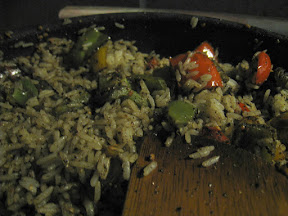
Fried rice with bell peppers


Tomato and onion chutney


Coconut chutney; Indian rice; raw onions with cumin powder and lemon juice; raw cucumbers and tomatoes; and cilantro.


The meal was met with near universal acclaim. Those who had been to India recognized the taste, and those who had only been to Indian restaurants in Korea recognized our superiority. Some fell for the beans, some for the rice; for me, it was the coconut. Even Mathan, who spent his first twenty-five years eating authentic Indian cuisine, said everything tasted as good as what he and his other Tamil friends make when they miss home. There was one woman, who had never tried Indian food before, who wasn't a huge fan, but I'll just win her over with something else next time.

We subdivided the labor, with Mathan assuming responsibility for the fried rice and tomato chutney, me for the bean curry and coconut chutney, while Niall did duty as a double souz-chef. Thus, regretfully, I can only present you with two recipes.

First, Rajma Masala, adapted from this recipe:

1 cup of (pre-cooked) beans, 1 tomato (not quite diced), 1 onion (diced)
3 cloves of garlic, about an equal amount of ginger, 1 or 2 spicy peppers, minced
1 tsp cumin seeds, 1 tsp coriander powder,, 1/2 tsp cumin powder, 1/2 tsp garam masala, 1/8 tsp turmeric, salt

(I don't pay much attention to spice proportions, partially because I don't want to bother with measuring and partially because stuff always comes out fine anyway. The important thing with Indian, I find, is to go really easy on the turmeric.)

1) Fry the cumin seeds over a medium flame for a minute or two in the cooking oil of your choice, then add the onion, turn the flame down, and give it five or ten minutes to get soft and translucent.
2) Add the garlic and ginger and cook for a minute or two.
3) Add the chilis, tomatoes, and all the spices except the salt. Roast for a minute or two.
4) Add the beans and about a cup of water. Salte to taste. As the water boils out, mash in the pan so that it becomes a little thickery.
5) Once the water has boiled out, you're ready to serve.

This recipe will give enough for about two people, if you have rice and something else on the side. I like it so much - particularly the rich, creaminess of the beans and the bite of the little chunks of ginger - that I could probably eat the whole thing myself. For the group, I tripled the recipe and added about an extra cup of beans to make it a little more hearty and filling (never a bad idea when you're cooking for ten).

Second, the coconut chutney, passed to me by word of mouth from Mathan's mother in Tamil Nadu. I don't quite remember the proportions, but something like this.

1.5 coconuts, cut into fingernail-sized pieces.
3 hot chillies, cut similarly
10 cloves of garlic (could be wrong on this), and about half that much ginger.
Tamarind (about equal to garlic)
2-3 tbsp split chana dhal
A few pinches of salt

Combine in food processor with a good amount of water. Keep blending and adding water as necessary, until it becomes a kind of dense, grainy cream, much heaver than Baba Ganoush. This chutney has a really interesting flavor: creamy and rich from the coconut, a little crunch due to the dhal, spicy thanks to the chillies, and a deep tang courtesy of the tamarind. It's amazing if you have time to chill it and let the flavors settle together before serving.

So, that was that. The next event will likely be held on the 9th or 16th of May, depending on whether or not I go out of town for our school's sports week. So, I've got at least a few weeks to think about what to serve. I'm thinking of trying my hand at bean burgers. If you know a good recipe, or have another suggestion, let me know!

May you all soon enjoy a delicious, home-cooked, eco-conscious meal with your friends!

Tuesday, April 12, 2011

More press!


Now, in addition to having published two articles, I've been quoted in one. The Korea Herald, one of Korea's biggest English newspapers (if not the biggest; really, I have no clue) recently ran an article on veg*anism here in South Korea.

Here's what she got from me:

"Daegu Vegetarian Club is soon to start group dinners, and the Green Consumer’s Alliance organizes a weekly vegetarian dinner there. They discuss the ecological significance of food."

and

"“I know Korean food now far better than I did when I was eating meat, since the limitations you accept by becoming a vegetarian encourage you to seek out new options,” said Roy. He often eats meat-free dinners with his friends, most of which eat meat, and recommends that everyone try a vegetarian restaurant once a week to experience new dishes."

As well as a link to my Daegu Green Living blog! Woohoo!

Some other Korean vegan bloggers (including Mipa of "Alien's Day Out," whose blog I of course follow steadfastly) were also quoted. Hurrah!

While I'm excited about having been able to bring my views to a large audience and about having managed to get some exposure for DGL, I feel a little uneasy about the interview process itself. The author contacted me through the Facebook group "Vegan Korea." Or, rather, she contacted the group admin, who sent out a message asking if anyone wanted to be interviewed for the article. I volunteered, and the author sent me a list of questions, which I answered at length. I'm not at all disappointed that she pared my answers down - that was completely expected and justified - I'm just a little weirded out by how little my identity was checked. Is it really possible to find decent sources by sending out a Facebook message asking who wants to contribute? Of course, we vegans are an inherently trustworthy bunch*, so in this case I'm sure everything will work out OK.

I dunno, it's midnight and I don't feel like raining on my own parade. Vegans 3, Industrial Food System Complex 1 Billion. Things are lookin' up!

*Facetious comment!

Tuesday, April 05, 2011

Brought to you by a Chinese character

I believe a while ago I wrote an extremely entertaining post about the etymology of some Korean scatological terms.

Well, recently, another one has come to the foreground in my life. I hereby introduce to you:


Jap

(pronounced like "chop," but with a j)

I would make it a million times bigger if I knew how.

It's the Chinese character for "mixed up" and it's in some of my favorite Korean words, like:

Jap-chae (mixed vegetables,): an excellent veganifiable dish made of sweet potato noodles, thin-sliced spinach, carrots, onions, mushrooms, peppers, all tossed with a light sesame oil dressing.
Jap-gok (mixed grain): rice and split legumes of various kinds, all mixed together. So much healthier than white rice!
Jap-peullaseuteek (mixed plastic): the bin where you throw out your unrecyclable recyclables
Jap-cho (mixed grass): weeds
Jap-nom (mixed indecent fellow): bastard, son-of-a-bitch

And, most recently
Jap-saeng-gak (mixed thoughts): monkey mind, ie random, distracting thoughts that come up of their own accord while you're working or meditating.