Mike Map


View Mike Map in a larger map

Saturday, April 02, 2011

Vipassanagain

Beop-sung (a Korean monk): Silence is the path by which a human becomes himself. For us to become anything at all, we must learn the silence of the seed buried in the ground.

John Taylor Gatto: The children I teach have no time... After television, schooling sleeping, and eating, they have only about nine hours each week to spend on growing up.

Blaise Pascal: All of man’s unhappiness stems from his inability to stay alone in his room.


Like to try a little experiment? Turn off your jukebox. Close your eyes. Direct your attention to your nostrils and the area just under them. Breath slowly, naturally, and see if you can feel the air moving across your skin as you inhale and exhale. No need to count, or visualize, or say "in, out," or anything like that. Just breathe and feel. Try to keep it up. Only for a minute or so. Go!


__________________________________________

Did you try? How long did it take for your first random thought to pop up? What was it about? Some recent conversation? Some person in another place? Some bit of work you need to finish? Maybe something a little more distant in time? How long did it take you to notice that you were thinking about something other than the present moment, and how long did it take you to return to your breathing, if you did at all. How long did it take for the next thought to pop up?

Are you at all curious about, or bothered by, the fact that you don't know how to just sit down and be completely in the present? I am. I have been, ever since my sophomore year of college, when I first ran into Pascal, his Pensees, and the aphorism I quoted above. I suppose there are several ways to take this statement, but what struck me was this: we're always looking for something outside ourselves to provide us with entertainment, or solace, or happiness. Who can even imagine simply sitting, with no books, no TV, no work, no conversation, and simply experiencing being for a few moments? Why is so much of our action at bottom just distraction? What are we distracting ourselves from? Why is it that, even when we are alone, in the dark, in the quiet, our minds insist on jumping back and forth between the past and future, between memories of pain or pleasure, fears of failure, dreams of success, and thoughts of little, banal tasks that we'd rather not be bothered with?

So, yes. If you're curious about this, please read on. I would like to tell you about Vipassana. Again. But better than I did last time. I think I can.


Last time, I wrote a lot of objective stuff - about the place, about the schedule, about the theory. Maybe that's because last time, that's all that I really took in. I spent most of the time shifting around on my cushions, trying to find a pose I could hold for an hour. Any time that wasn't spent shifting around, I spent doubting and debating and disproving the contents of the lectures. By the sixth or seventh day, dismayed by a perceived lack of progress, I felt that the technique wasn't for me and more or less fizzled out. It was too late to go home, but I was too tired to try to meditate, so I mostly just looked out the window and listened to the chickens.

On the final day, once the silence had been lifted, I overheard a conversation between one of the new students (a man in his 30s) and returning student (a guy slightly younger than me). The new student asked the old one why had decided to do Vipassana a second time. The returning student replied "because I had forgotten how much it hurt. This is the last time." I thought to myself, "Wow. What strength. He knows how to differentiate between something being too hard and something being just plane wrong; how look at something and and say 'that's not for me' rather than 'I'm not good enough for that.' He doesn't feel weak or inadequate, and doesn't equate choosing something else with giving up."

That was more or less my mindset when I left the first course; I still felt, for very hazy reasons, like meditation was something I ought to be doing, and something I ought to be able to do, but I wasn't sure if I could. I didn't meditate at all after returning home, let alone keep up a daily practice like the teacher suggested. I felt conflicted about whether or not to do it again, and was relieved to see that the one course offered in Korea this winter had been canceled. I thought I could push off the confrontation for another semester at least.


How wrong I was! As I may have mentioned in mid-February, the manager of Nunbisan Village, where I lent a hand tending chickens for a few days, knew a teacher nearby who was running an unofficial/unlisted course. He offered to call the teacher on my behalf, sign me up, drive me there, and stay for a day or two. I had already been sort of freewheeling around the province for two weeks, bouncing and forth between Nunbi, another research organization called Heuksallim (the subject of an eventual future post), and Heuksallim's farm, sort of sleeping wherever there was someone to host and entertain me. Having sort of already given myself up to circumstance/fate for the duration of my trip, I figured the opportunity was too special to pass up.

It turned out to be a good decision, or rather lack of a decision. My experience this time was completely reversed - rather than fizzling out and going home disappointed and frustrated, I came out of the course energized, lighter, and happier, so much so that friends who saw me upon my return said that my face and voice had both changed. After the first course, I wanted to want to meditate, but didn't; after the second, I just plain want to, and have been. At the beginning of the semester, I managed to wake up at six each morning and do an hour; now, things are in full swing and work keeps me fairly exhausted, which means I only manage to medidate for two or three hours in a good week. Sometimes I'm too tired, and sometimes I forget how nice it is and just let myself get distracted, but when I finally come back, sit down, wrap up, and start to breathe, I think to myself: "Finally. What took me so long?"

I hesitate to talk about it, since I don't think I can really do much to communicate such subjective and internal changes without sounding like I've gone off the deep end. This is particularly true over a distance, when all you've got is my words, and you can't see directly whether or not I've changed in the ways I'm mentioning and in other ways I havnen't. And yet, I want to try, since I think the courses have helped me to feel happier, more stable, more energetic, and more hopeful. After all, what's the point of blogging, if not to share this kind of stuff?

--------------------------------------------


Vipassana is at once the easiest thing I've ever done, and the hardest; maybe it feels hard because it sounds so easy. No duties, no distractions, no diversions, no mundane concerns of any sort for ten days. Doesn't that sound like a dream vacation? Au contraire - it's extremely tough. Or rather, you let yourself make it tough. In talking with the other participants after the program, I found that not a one hadn't contemplated giving up and going home, whether out of boredom, pain, depression, frustration or something else. I realize this paints a bleak picture, but remember: most people overcome these obstacles, very few leave the course, and many go back for more.

There are two main segments to a Vipassana course. The first, Annapanna, takes up about the first third. Annapanna is what I asked you to do at the beginning of the post: attempt to empty your mind of thoughts by focusing on breathing. Other meditation traditions ask meditators to focus on counting, visualizing, or repeating a mantra; Vipassana, which aims to give us direct experience of the truth about our minds and bodies, asks the meditator not to activate his or her will at all, to only sit and observe the truth of the body in each instant. Is the air passing through the left or right nostril? Is the breathing deep or shallow? Does the air you draw in scratch your lip? Does the air you breathe out warm it up? At first, sensations are faint, if present at all; thoughts pop up and distract you, and as soon as you realize it, you clear them away and go back to breathing. As time goes on (Vipassana meditators do about ten hours of meditation each day), you become more sensitive, feeling differences in humidity, temperature, and forcefulness of breath, in addition to unrelated other sensations: tingles, tickles, twitches, and so forth.

The point of all this is to develop sensitivity so that you're ready for the latter two-thirds of the course, in which you practice Vipassana, the observation of things as they really are. In less metaphysical terms, this means sitting and mind-patrolling your entire body, part by part, for whatever sensations may occur. At first, you notice the things you'd expect, big stuff: cool breezes, flies landing, beads of sweat, your pulse, and, of course, terrible, seemingly unbearable leg and back pains, the kind that kept me squirming throughout the first course. You have to struggle to focus on areas where there's apparently no sensation; but the longer you stay at it, the more sensitive your mind becomes, and the more you can feel things you didn't even know existed. You come to realize that these sensations are always present, on all parts of the body - how could it be otherwise? We all learned in middle school that our bodies are composed of organs, and organs of tissues, and tissues of cells, and cells of tinier parts, and that those parts are composed of molecules, which are made of atoms, which are made of subatomic particles, which are made of smaller stuff yet. Every single one of these components is in constant action, whether it be physical, chemical, biological, or intentional. Why is it that we don't feel the heart beating, the skin breathing, the mitochondria contracting, the cells dividing, the electrons orbiting, and the quarks blinking in and out of existence a million times a second?


This sounds so odd that I think a little allegory might be useful. When I first started trying to meditate, long before I knew anything about Vipassana or before I had even discussed meditation with anyone, I had some interesting experiences with my pulse. If I tried to focus my attention on one of my fingers, my pulse felt strongest there; if I moved to, say, my kneecap, then after a few seconds, my pulse would move too. No matter where I directed my attention, my pulse followed. I didn't quite know what to make of it, and I didn't know who to ask, so I just kind of let it be. It wasn't until recently that I realized what should have been obvious from the first: my pulse never moved at all. My pulse runs to every part of my body all day, every day, at every moment, and if it didn't, I wouldn't be around to notice the problem. It was only my awareness that had changed; after a few seconds of calibration, of quiet observation, sensations that are usually too subtle to be perceived become easily noticeable.

As with the pulse, so with other sensations, though not all of them are so easy to identify. Parts of the body stretch and compress, heat up and freeze, buzz and go into paralysis. As you learn to pay attention to the sensations, and to ignore the ones that occur on parts of the body you're not focusing on, you feel more and more of them, including ones for which we lack words. You may eventually feel your entire body vibrate, or petrify, or even dissolve. You may be able to observe sensations inside your body, not just on the surface. (I experienced some of these and not others; I won't tell you which. It's not particularly useful to talk about what any given individual felt, since all of us are so different in terms of physical and mental experience. Reading about others' experiences only makes you jealous, which will hamper you from developing on your own. Suffice it to say, I had enough to let down my doubt and let the technique take me where it would.)


You may still be asking, so what? You could probably postulate a good evolutionary reason why we wouldn't want to be aware of these sensations all the time. How could we avoid predators if we spent all day reveling in our particles' vibrations? How could we remember the past and plan for the future if we were completely mesmerized by the present? I constantly asked myself questions like these during the first course, rather than just giving the technique a shot; I still ask them now. But, if you let go of them for a time, you come to realize that it's not an all-or-nothing scenario. Being able to experience your body and mind as they are doesn't mean that you're unable to react to what already did happen or provide for what is likely to. On the contrary, understanding the way your mind has been conditioned to react to sensations like these makes you all the more powerful and effective.

Actually, I've only explained about half of the course so far. A great deal of time and energy is spent on developing awareness of sensory perceptions, but this awareness is not an end in itself. The point of the whole enterprise is to give you direct experience of the transience and therefore absolute arbitrariness of these sensations. Strong or subtle, pleasant or painful, novel or not, all of the sensations vanish shortly after they appear - and this is more true the more time you spend observing them. An unpleasant sensation may be unpleasant, but fearing it, fighting it, and generating aversion towards it only multiplies the effect. Why choose to multiply your own suffering? Likewise, a pleasant sensation may be pleasant, but it's guaranteed to vanish; all the anticipation, expectation, and craving that you generate for it will eventually be for naught. So, when your face starts to itch, don't scratch it; when your mind starts thinking about what you should do next weekend, don't indulge it; when your goes numb and feels like it may explode, don't move it; when you start to feel an infinite number of pleasant subtle sensations all over your whole body, don't get attached. Keep in mind that it will all go away.

If you can learn to treat all sensations with this kind of objectivity, you've already taken the most important steps towards remaining balanced in the face of larger, more complicated, emotional issues. After all, moods and emotions fluctuate every bit as much as the random sensations on your skin. I recall being extremely depressed on Day 2, so much so that I thought of running away from the course and visiting a therapist friend in Seoul; so happy and overwhelmed by gratitude on Day 6 that I couldn't fall asleep; and so angry on Day 7 that rather than meditating I sat with fists tightly clenched for two hours. And yet, nothing had really happened to me during that period, or at least, nothing that could justify jumping around from despair to elation. The dizzying ups and downs were all of my own making. Just like the pain in my right knee, the one the kept me squirming throughout the first course, the one that mysteriously vanished sometime during the second, the one that hasn't come back since.


Treating the pleasant and unpleasant alike may sound like a recipe for total ambivalence - another of the thoughts I wrestled with for far too long - but it's not. It teaches wisdom, understanding, and peace. Longings become mere "would-be-nice-ifs," frustrations become "oh wells," annoyances become trivialities; not all at once, and not all the way, but enough to make a difference in how you feel. Now, personally, I feel more free to go after things I believe are of value and to ignore things that aren't, less hampered and dismayed by setbacks, more grounded in times of conflict, and more patient and compassionate in general. I'll admit that I don't exactly understand how equanimity in the face of low-level bodily sensations is supposed to generate total piece of mind; then again, I don't know how hitting clicking the little orange "publish" button will transmit this post to you. I've just clicked it enough times to be pretty sure it will. Likewise, I've spent enough time meditating to be fairly convinced of its effects.

I don't expect these words to convince anybody of anything. Not only are the words poorly chosen and sloppily organized and incomplete; they're also too distant, too abstract, too impersonal, too forced. I could write on and on, trying to define terms better, give livelier examples, and make tighter arguments, but I don't think it's worth it. Words can only take us so far, and in many cases are even counterproductive. A year ago, just listening to this stuff would probably have turned me off. In fact, I still hold doubts about maybe half of the things I wrote here, probably even more than when I began writing. That said, enough happened to me during the course - from new sensations to extreme mood swings to the total disappearing of what had been such an unbearable pain - to convince me of the soundness of its basic premises. And since then I have felt different, better, more confident, so much so that I wish I had found Vipassana earlier. Had I gone into the first course with even a tiny, vague, endorsement such as this from a person I knew and trusted, I think I could have opened myself up and learned more, and more quickly, saving myself a lot of wasted time and struggle. While in the end the only thing that matters is your own experience, in the beginning, words from a friend can count for a lot.

I'd like to end with one more conversation I overheard. Vipassana meditators maintain silence all day, but have a brief opportunity to speak to the teacher and clarify issues of methodology. I often stayed to talk for a minute or two, and usually the teacher called me first, maybe because I was one of the returning students, or maybe because I was a foreigner, I have no way of knowing. One night, though, he called the guy next to me up first instead. I tried not to listen (as I said above, it doesn't do you any good to know how enlightened or pitiful the next guy is), but I couldn't help it. The man, also a returning student, wanted to go home. He said he was tired, and depressed, and not getting anywhere. Here's what the teacher said:

"You've already come so far. You've finished one course and are halfway through another. Most people live their whole lives not even knowing a wonderful technique like this exists, never having a chance to meet it. Particularly in Korea, where other forms of Buddhism have taken hold, and been degraded. You must have done so much good, built up so much positive Karma in a past life, to have had the good fortune of encountering these teachings in this one. Don't throw it away."

I believe you can take that as a compliment.

Monday, March 21, 2011

Green peeve 1: Staggered automatic doors.

I know I'm critical of a lot of things. Mac n Cheese, shopping malls, plasma TVs, my school's English book, and all that stuff. However, I do make an effort to be constructive, to do more analyzing and informing than complaining. That is, until today.

Because, even though I know useless complaints about tiny details won't get anyone anywhere, sometimes it just feels good.

So here's one thing that's been pissing me off lately:

Homeplus (basically a Korean Walmart, owned about 20% by Korea's Samsung and 80% by England's TESCO, or so I hear), being a gigantic store, has gigantic entrances. Whether for fashion or insulation or some other purpose, the entrances always have two layers of doors. That is, you pass through the first set into a sort of antechamber, and then, after about two or three more meters, you pass through another set and into the store proper. Maybe because doors are difficult to open, or because shoppers are too exhausted after agonizing over which of the seven thousand varieties of Pringles they really want, or because touching things is dirty, some of the doors are automatic.

But that's not the peeve. I have come to accept that there are a billion stupid, crappy, destructive things about the world that I will never be able to change. I just go about my business and avoid them as much as I can. Plain old automatic doors go into this category.

No, the problem is not with the doors themselves, per se. It's with their arrangement. Have a look at the diagram:
INSIDE
AAAAA/AAAAAGGGGGHHHHH/HHHHH


HHHHH/HHHHHGGGGGAAAAA/AAAAA
OUTSIDE
(Legend:
AAAAA:Automatic sliding door
/: Gap between doors
HHHHH: Hinge door
GGGGG: Glass plate. )

In an effort to use my body rather than electricity, I usually go in through the first set of HHHHH doors. Notice, though, that I can't continue straight through, because the next set of doors is AAAAA! For no good reason that I can think of, I am cornered into an environmentally unfriendly act, like when they drop two tiny, pointless strips of beef into the would-be-vegan soup at the faculty cafeteria. Of course, I can try to take the H-H diagonal path; but even then, it's hard to avoid tripping the A sensors across from me. Theoretically, it would be possible to enter at H, slink spy-style until the center of the G's, cut into the middle before I trigger the A's on the right hand side, and then pop in through the other set of H doors. But, in the real world, I'm already white, ponytailed, and usually wearing torn-up clothes appropriate for bicycle rides ( during which nobody will see me for more than about three seconds at a time). I don't need to appear any more freaksih by looking like I'm playing hide-and-seek (alone) in the store entrance.

Unable to realize my low-impact ambitions, I tend to opt for the freegan strategy: wait for someone who has no qualms about using AAAAA doors and the sneak in right behind them. Nice and close. Creepily so. Sure, I go through the door that I hate. But I don't cause it to open, and therefore don't contribute to any pointless use of fossil fuels. Just drafting, along for the ride.

Veritably, life is like a hornet's nest.

Does anyone else out there have any particularly peeving green peeves they just want to vent about? Or suggestions for me? Or other ways that you apply this dumpster-diving methodology to your life?

Sunday, March 20, 2011

DGCL's CSBS at my house! Almost!

Sometime back around December, as I must have mentioned, I started frequenting the "Daegu Green Consumers League"'s Tuesday-night "Vegetarian Dinner for the Good of the Planet." Each week, we gather at "The Warehouse" (the name of the meeting place), and a woman named Mina cooks a meal for us. There are about five regulars (I now count myself among them) and another five or so who come from time to time. Nobody else - except my buddy/neighbor/co-chef Suzie - is a vegetarian, but everyone tries it once a week in order to reduce the strain they know meat-eating places on the planet.

Last week, Mina went on a trip and wanted to cancel the event, but I wasn't gonna let that happen. Instead, I coerced Suzie into helping me host. So, we invited the League over for dinner. Here's what we made:


An unplanned leftover salad (my creation)! Mini sprouts, baby greens, lettuce, carrots, cucumbers, old bell peppers, a few kinda squishy cherry tomatoes, a beet I didn't know what to do with, and roasted perilla, pumpkin, and sunflower seeds. Dressed with olive oil, white wine vinegar, and some Italianish herb mix so kindly procured and exported by my mom.


Croutons made with multi-grain sesame bread, olive oil, and just a hint of salt and pepper. All credit to Suzie for these.


Suzie's pumpkin/carrot soup, with just a hint of curry.


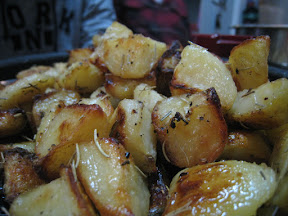
Potatoes Donatella-style. I learned this from my host mom in Padova in 2005. Just cube the potatoes, swish them around in a mixing bowl with a bit of oil, salt, and rosemary, and then roast them for an hour. Suzie added a little twist: steam the potatoes first, so that they're a little squishier on the inside, but still nice and crispy outside.

I also woke up at 6 that morning to makee a giant pot of chili in the slow cooker - kidney beans, black beans, tomatoes, tomato paste blended together with an onion/bell pepper/garlic/red pepper powder sautee. It came out tasting OK, but was a little ugly, so there's no picture.

For dessert:


Some fresh fruits (yes, unfortunately, mostly imported, but all bought at about 11pm the night before from the shelf of past-expiration date stuff that the store was going to throw out anyway...) that we used to make:


Low-energy CHOCOLATE FONDUE, the heat source for which was just 3 tiny little candles. Amazing.

And here's everyone having a great time:


This was my second time co-hosting the event with Suzie. It's a bit stressful in the moments beforehand, trying to whip everything up in the one-hour gap after work and before everyone shows up, but it really winds up being a blast making good food for your friends - particularly if you can make stuff they're not likely to have tried, even if the ingredients are all available.

Ah, also, the whole meal cost just about 5 bucks a person, and that's counting about five servings of leftover chili, too! I deceive you not!

Mina's out of town next week, too, which means that the 지구를 위한 채식 밥상 is coming to my place.

The menu is:
-Suzie's roast sweet pumpkin appetizer (uncharted territory for me.)
-Indian style cabbage curry (I made a test batch today - easy and delicious^^)
-Thai style curry with potatoes, coconut milk, and whatever other vegetables are available when I swing by the organic shop tomorrow (also going to be a bit of an experiment).
-Mixed-grain rice, perhaps with some sweet potato slices mixed in for good measure.
-And perhaps, if everyone is lucky, my patented peanut-banana-soy milk-powder of roast grain supershakes.

Can I just say, nothing beats food with friends?

Saturday, March 19, 2011

Next Article

The following article was printed in In Daegu, a new newspaper from the makers of Daegu Pockets.


The full text and Korean translation follow.
To download the pdf, click here.

Have you ever been sitting at a Daegu bus stop, watching the ticker and wondering why the bus you’re waiting for doesn’t seem to be getting any closer, when all of a sudden a packmof shiny spandex-clad cyclists races by? Hundreds of men, women, and children riding bikes of all different types and sizes, from giant unicycles to low-riding, stylized tricycles, from million-won designer models to that rusty one that has been lying on its side next to KNU’s North Gate for at least three months now. What are they all doing?

Welcome to the Daegu Bike Festival. Funded by Daegu City Hall and organized by the Daegu Council for Local Agenda 21 (맑고푸른대구21추진현의회), the DBF is an opportunity for cyclists of all shapes and sizes, ages, races, and levels of ability and dedication to enjoy themselves while at the same time demonstrating that Daegu is indeed a bikeable city. From humble beginnings in 2006, the DBF has grown into an event that regularly attracts hundreds of riders, and sometimes more – over one thousand people participated in last October’s event, the Daegu Bike Rally, a leisurely 25 kilometer course from Daegu World Cup Stadium to the main gate of Keimyung Univeristy. (Actually, all the way to the cafeteria. Followed by free lunch.) Other rides last year included a scenic ride along the Nakdong River in May and a loop from downtown to Dusan intersection and back to celebrate Daegu Car-Free day in September. Every ride begins with signing in and picking up your raffle ticket and ends with dozens of gifts, ranging from the small (helmets) to the big (bicycles) to the just plain strange (environmentally-friendly frying pans).

The DBF represents more than just a chance to win some free stuff, though. For the chronically lost, the process of finding the starting location, following the course, and making your way back home from the destination is an excellent way to learn the layout of the city, while the chronically bored may encounter restaurants and shops that might otherwise have gone unknown. If thoughts of giant carbon footprints weigh heavy on your conscience, DBF events may be a chance to get started doing some good. If you’re interested in bicycles, bike fashion, or bike-mounted gizmos, you’ll have plenty to feast your eyes on. For those looking to meet other bicycle enthusiasts to arrange rides with, there’s no better place to be. If you like to feel important, you can ride at the front of the pack, right next to the police escorts. And if you’ve been waiting for an opportunity to parade around in public wearing spandex, well...you aren’t alone.

The final DBF event of 2010, a 14-km ride along the banks of the Geumhogang River, took place in November. DBF will begin its 2011 campaign on March 26th (hopefully the cold will have passed by then) with a ride starting out in front of the West District Office (서구청). The exact time and course have yet to be decided; for up-to-date information, and to register for future events, have a look at http://www.ecobike.org.

DBF events are always free of charge and always open to one and all. So far, few foreigners have heard about or participated regularly in the festivities. This year, let’s ride together in order to raise awareness, while at the same time helping to make a cleaner, healthier, more friendly Daegu.

--------------------------------------

If you're interested in finding out about eco-friendly restaurants, shops, and events in Daegu, please visit http://noksaeksari.blogspot.com or find the group 녹색살이대구 / Daegu Green Living on Facebook. Feel free to stop by one of our monthly Eco-film nights, held downtown at Buy the Book.

대구 버스정류장에 앉아서 전기 간판을 바라보며 당신이 기다리는 버스가 왜 오지 않는지 궁금해 할 때, 갑자기 반짝이는 스판덱스를 입은 수백 명의 사이클리스트들이 순식간에 지나가는 것을 본 적이 있나요? 남녀노소 할 것 없이, 다양한 사람을이 다양한 자전거 – 커다란 외발 자전거에서 누워서 타는 세발 자전거까지, 백만원을 호가하는 명품 자전거에서 경대 북문에 3개월 이상 망치되어 누워 있는 녹슨 저전거까지 – 를 타고 다닌다. 신기하지요? 그들은 무엇을 하고 있을까요?

대구 자전거 대행진 (DBF)에 온 것을 환영합니다. 대구 시청의 재정 지원을 받아 맑고푸른대구21추진협의회가 진행하는 자전거대행진은, 체격과 나이, 인종과 실력, 참여 경혐과 상관없이 많은 사람들이 즐거운 시간을 보낼 수 있다. 동시에 대구가 저전거로 쉽게 다닐 수 있는 도시임을 입중할 수 있는 좋은 기회이다.

2006년에 시작된DBF의 처음은 미약했지만, 계속해서 많은 사람들이 참여하면서 이제는 수백 명의 사람들이 참여하는 행사가 되었다. 작년 10월의 대구 자전거 랠리 (대구 월드컵경기장에서 성서계대정문까지 25km코스를 편안히 따라간)에는 천명 이상이 참여했다. (사실, 계대 안 식당까지 갔지요. 밥을 공짜로 먹기도 했고.) 작년 행사에는 5월의 낙동강을 따라 간 코스와 9월 “대구 차가 없는 날”을 경축하기를 위한 시내에서 두산오거리 일주를 거치오는 코스가 있었다. 모든 행사는 접수하고 경품권을 받는 것으로 시작되며, 수십 개의 경품 – 작은 것 (헬멧)과 큰 것 (자전거), 이상한 것도 (친환경 후라이팬) – 을 선물하는 것으로 끝난다.

하지만DBF는경품을 얻는 기회만 있는 것은 아니다. 길치에게는, 출발지를 찾고 코스를 따르고 집에 다시 돌아 가는 길을 찾는 과정에서 우리의 대구광역시의 모습을 배울 수 있을 것이다. 또한, 만성적으로 심심한 사람들은 알 수 없었던 식당과 가게를 맞닥뜨릴지도 모른다. 자동차가 뿜어내는 오염에 대해서 많이 고민하는 사람들에게는, DBF는 좋은 일을 시작할 기회가 될 수도 있다. 만약에 자전거와 저전거 패션, 그리고 최신 자전거 악세서리에 관심이 있다면, 구경할 것들이 많을 것이다. 자전거를 좋아하는 친구를 찾는다면, 이보다 더 좋은 곳이 없을 것이다. 주목받고 싶다면 경찰 호위대 바로 옆에 타면 되고요. 마지막으로는, 스판덱스를 입고 잘난 척할 핑계를 찾는다면, 이곳으로 오세요. 당신이 혼자가 아니다.

2010년의 마지막 행사는 11월 금호강을 14km 따라 가는 코스이었다. 2011년의 캠페인은, 추위가 지난 다음에 3 월26일 서구청 앞마당에서 시작될 예정이다. 그행사의 시간과 코스는 아직 정확하게 정해지지 않았다. 그래서 자세한 정보를 찾고 싶거나 앞으로 진행될 행사에 신청하려면, http://www.ecobike.org에 접속하면 된다.

DBF은 늘 무료로 진행되고 누구나 참여할 수 있다. 지금까지는 대구 자전거 대행진에 대해 잘 알고 정지적으로 참여하는 외국인이 매우 적었다. 올해는 저전거를 같이 타는 것을 통해서 사람들의 인식을 높이는 동시에 더 깨끗하고, 건강하고, 사랑스러운 대구를 만들도록 노력합시다.

______________________________

다른 친환경 식당, 가게ㅘ 행사를 더 알고 싶다면 http://noksaeksari.blogspot.com 방문하거나 페이스북에서 녹색살이대구 / Daegu Green Living 이라는 그룹을 찾아 보는 것이 도움이 될 것이다. 매월 시내 Buy the Book에서 상영될 친환경 영화 관람에 누구든지 환영합니다.


Some slightly good news for pigs, amidst lots of really terrible news.

Wrote this for the other blog, but it's personal enough to reprint herre:

_________________________

I believe that we all have our "veg buttons." Soft spots that, when poked, make us cringe a little more than we expected, that activate our introspection, our guilt, our sense of right and wrong. If the right veg buttons get pushed, and often enough, and at the right times, one begins to feel differently about vegetarianism. One doesn't immediately begin to think it's absolutely right, or that it's the only way, but automatic reactions and unquestioned assumptions - "they're not human," "out of sight, out of mind," "I need it," "I have a right to it," open up, get exposed, become vulnerable. A little prodding feeling - maybe there's something to this? Those who try it aren't crazy. It becomes something to consider seriously, and even try.

For me, there were three such buttons. First came a plain piece of paper taped to the wall at my parents' church, saying that it takes tens of thousands of gallons of water to get a kilogram of industrially-raised beef. It didn't change my behavior at all, but it has stayed in my head for years and years. What's the point of taking short showers, and wishing that others would too, when my occasional trip to Outback uses up more water than a month's worth of hygiene habits?

Second was a truckbed full of pigs that I saw here in Korea. I wasn't even out in the countryside - actually, I was on my way to Costco. There were four or five pigs in the back of a decent-sized truck. They weren't squished in or anything. But one pig - and there's no pretty way to say this - had what I can only describe as a couple giant malignant ass polpys. (Ok, to be honest, I could also describe them as giant rectal warts.) I should probably describe them in detail for multiple impact, but I couldn't do it justice and the mere thought of trying makes me want to vomit. I didn't go veg for another year or more after seeing them, but from that day on, each time I sat down to grill some pork, the image floated up in my mind. Could this very bite be from that pig, or one just like it?

Third was something Michael Pollan said about poop. Before agriculture depended on chemical fertilizers, it depended on natural ones; feces were a resource. Animals evacuate, bacteria break down, plants absorb, animals eat, and evacuate again, and humans step in every now and then to skim a little surplus off the top of the process. Now, though, the bacteria don't break down poop, because it goes to giant lagoons where nothing can grow, not to fields where other lifeforms can make use of it. Thus, whatever nutrients are in the poo are unrecoverable, wasted; we have to turn to chemical fertilizers, and the oil that it takes to make them. The fertilizer runs into rivers and oceans and disrupts natural patterns; the oil burns off into the air and does the same. Things may have not been easy or perfect or ideal before before, but somehow, for some reason, we took a closed-loop solution and made two, if not three or more, problems out of it. Now we have a waste problem (what to do with all that shit?), and a fertility problem (how can we grow enough to feed all these animals). The answer is right in front of us. We spent millennia living with the answer. How can I keep eating meat when I know it contributes to this kind of ridiculousness?*

So, those were my veg buttons, or at least the big ones, the ones I remember, the ones I still think about. It seems that, recently, many Koreans have had their veg buttons pushed - not by churches or polyps or Pollan, but buy the outbreak of foot-and-mouth disease. Reports of millions of pigs and hundreds of thousands of cows being killed, often buried alive; speed bumps that shoot up geysers of chemical baths, and highway tollgates that get you from both sides; quarantines and canceled trips; chemical-soaked carpets in train station; increased food prices. According to this article,, "Disgust over FMD gives boost to vegetarianism" from the Jungang Daily , interest in vegetarian (and even vegan!) eating practices is on the rise**. The vegetarian buffet at Seoul National University's music school is filling up, and visits to the Korean Vegetarian Union website have quadrupled. The outbreak has shaken some people from ignorance into awareness, and some from awareness into action. If there's one good thing that can come out of the various crises we face - whether they're related to the environment, to energy, or to livestock - it's this: they make us face up to what we're doing, or what we're allowing other to do instead. They force us to confront our actions, our systems, and ourselves, and the necessity of changing them all.

What a good time to be trying to find a role as a vegetarian/environmental activist in South Korea!***

_________________________

*I know that the solution is not easy, and that there's no way now to just capture all the shit and take it Idaho.
** I owe the link to Mipa at Alien's Day Out
***At first I wanted to make a joke, starting that sentence off with "It's a bad time to be a pig, but..." Then I reconsidered. Too lewd?