Mike Map


View Mike Map in a larger map

Saturday, March 19, 2011

It's the first ray-ee-nee day, of the year.

A one month post dearth! A deep, unsightly gash in my blog's epidermis! The agony of a stifled desire to write, to share to good news, to recount excursions undertaken and lessons learned. To record anything and everything, for you, for me, for posterity. Time lost, thoughts unrecoverable, a black hole in my memory. And perhaps, lacking news from me, in your heart as well?

If so, I apologize. I'll make it up to you.

Today, I intend to put an end to all of the above. Because:

It's raining.
And I've got a sore throat.
And a giant pitcher of homemade honey jujube tea.
And a bag full of muffin top cookies made by my friend Sandy.
And, for the first time in what feels like forever, not a single obligation.
And a billion things that I want to share.

This post is just preliminary though. First, I think I need to take a nap and make a list and pot some plants. Then I'll be back.

In the meantime, watch this video! I originally started this blog thinking I'd be telling my friends what South Korea is like. How people live, how they play, how they talk, what they eat, where they go, stuff like that. All the little, mundane trivia that constitute "knowledge" of a place and its people. Over the past year, though, I think I've replaced whatever amount of "cultural relaying" that I was doing with a bunch of stuff about my fauxboing and experiments and opinions.

Which is to say, this video is a million times better than any official "Sparkling Korea" (I could do a whole post on ridiculous city monikers) toursit-lure video I've ever seen. Maybe it's just the histper-friendly soundtrack and editing, I don't know. But the way the scenes are cut to the beat, and the way the protagonists reappear a few times, makes the video feel like it comes from the heart (whereas official ones tend to feel like they came from the boardroom.)


(If you'd like, compare it to the official ones, search for "Korea Sparkling" or "Korea Inspiring" on YouTube.)

Wednesday, February 16, 2011

12000 Chickens.

2011 has been a slow year for blogging so far! I'd like to think it's because I've been keeping busy...


After the Idli party, I spent a few more days with Sadhana friends, then took a couchsurfer from Colombia, Jorge. A really nice, cool guy. He stayed for a week and we hung out a fair bit; I really had nothing to do except study Korean, write another article for Daegu pockets, translate it, and eat the candy he brought as a gift. After a week or so, he and his friend Isabel (who was staying with another host) found their own place near another university, where they're going to TA for Spanish classes while taking an intensive Korean course. I have already told them that they can repay my kindness by cooking me an occasional vegan Colombian dinner. Next semester is shaping up nicely...

I had planned to head off on my farming excursions around the beginning of February, but as Lunar New Year fell on the 2nd, 3rd, and 4th, the farmers asked me to postpone my visit until the following Monday. So, I spent Korean New Year alone recuperating from about 5 weeks straight of being excessively social (Christmas group trip, New Year's group trip, continuous Upo wetlands camp prep meetings, early January visit to see friends in Seoul, various environmental things in Daegu, Tobin's visit, Idli party, Couchsurfers), napping and reading and studying Korean and cooking and such goodness.

So, come Monday the 7th, I came out to NunbiSan Maeul (Snow-Rain-Mountain Village), a chicken farm about 3 hours northwest of Daegu. I found out about Nunbi not through WWOOF, but through Seon-ju, a Korean friend I met in Sadhana. She spent most of the last 5 years visiting different kinds of communities - Buddhist, self-sufficient, sustainable, et. al. - in Japan and southeast Asia, and she knows of some stuff here in Korea too. She hadn't been here yet but asked me to check it out.

"Chicken farm" isn't exactly the best way to describe Nunbi, but I don't know what is. I can't post any pictures now, but later I'll show you the 7 buildings, each divided into 10 or 25 smaller rooms, holding a total of abotu 12,000 chickens. You could walk a circle around the whole set of buildings in about five or ten minutes; it's not too big, but it's big enough that the chickens have ample space to walk, jump, exercise, and do their chicken culture stuff.

The design for the coops was apparently invented by a Japanese farmer named (something like) Yamagasi - I've only heard the name in passing and haven't seen it written yet. Wooden beams run the length of the back of each coop; the chickens jump up onto them to sleep, and since they're about a foot off the ground, the chickens can poop without stepping in it and dragging it all around. The water is in a tray at the front of the coop, far from the feces. The space in the middle has some troughts for food, and on the left and right side, hanging off the walls, are big triangular boxes. The base of the triangle is filled with hay, and the hypotenuse blocks out sun and light, so that the chickens have a dark, soft, warm place to lay their eggs. When the farmers/workers/members of the community come in, all they have to do is open up the hypotenuse, grab the eggs out of the hay, and move on. Because the boxes are so nice, the chickens hardly ever lay eggs on the ground, which mean few get stepped on, missed, or wasted.

The eggs that Nunbi produces are fertilized, which means that if they were left alone they'd hatch into baby chicks. This may sound a little cruel - actually, the chairman of the community, when he heard about my veganism, said that he'd rather eat unfertilized eggs than fertilized ones, which is an argument I understand - but the truth is that fertilized eggs mean happier chickens. Here at Nunbi, the ratio of roosters to hens is about 1:12-15, which gives an egg fertilization rate of about 95%. I'm not sure what the "natural" ratio would be, but in many standard (sterile) egg operations, the hens never encounter a male and thus never get a chance to mate or have a child. To me, this looks like their ability to express one of the fundamental traits of animals is being denied. Not only the physical acts of mating, conceiving, and laying, but also the social acts of courting, competing, showing off, or however chickens get on with it. I don't think one has to know the details in order to acknowledge the justice of allowing them some amount of freedom. Furthermore, even if roosters were present in most egg-laying operations, mating would probably be impossible, since the conditions are so cramped that the chickens can hardly move around, let alone strut, play, or mount one another. Fertilized eggs don't guarantee that the chickens have space to move, but they raise the likelihood. Finally, chickens in standard egg operations don't even live through full life cycles. After being caged and manipluated and worn out (by antibiotics, "enhanced" feed, and non-natural light cycles), they're killed as soon as their productivity drops. Most of these chickens, bread for egg-laying ability and not survival capacity, wouldn't even survive if let loose, even into good conditions; their bodies are weak, and since they never saw adult chickens foraging or mating, they have no clue how to get by. Fertilized eggs mean, at least to some degree, that the chickens have been allowed to express some of their chicken-ness. And there's no such thing as animal welfare without this freedom.

So, for 2 days, I woke up at 6:30, put on some nice tall boots, and went outside to pour hot water on the faucets, which freeze every night. Once they faucets are operational, the water is turned on so the chickens can drink. (In the non-freezing months, it's always on). Then I went through the coops with the young chickens, who haven't quite adjusted to the "don't lay your eggs in your own poop" system. I would throw a few handfuls of seed into the corner, and and with the chickens distracted and scattered, I was able to clearly spot and pick up the eggs that had been laid on the ground. If I saw a chicken preparing to lay an egg anywhere other than in the egg box, I picked it up and moved it to the egg box, both for its own comfort and ours. After a time or two, the chickens pick up the habit, and by the time they're six months old, they hardly lay on the floor at all.

Breakfast at 8:00, then back to the chickens at 9:00. We opened up the rooves to let the sunlight in, then one more round picking up eggs from the floor - yes, they lay them that frequently - then gathering from the egg boxes. A room with 100 chickens might produce about 50 eggs overnight. The eggs are set into temporary cartions, and then we drive them down to the little factory, where they are stored for the moment. Then we weigh out a bag of feed for each room (10 to 20 kg depending on the size of the room and the age of its inhabitants) and set it out in front of the door. Then we head in for lunch and a nap.

At 2pm, back to the chickens. They have a special long coo for when they're hungry, which I don't think I can transcribe. The tone is kind of plaintive (maybe that's just me projecting) and moves from low to high. Entering the coop, I'd toss some feed in one corner to get them out of the way, flip over their troughs to empty them out (chickens are not the brightest animals and often stand and poo inside the trough while eating), and then fill them with new goodies.

After that, miscellaneous time. On the first day, we made a special snack out of the eggs that were too ugly or damaged to sell. We boiled several hundred defective eggs, then mixed them (shells and all) with some organic nutrition supplements and some rice husks, and then I donned my boots again and stomped on the stuff until it got kind of pasty-clumpy. It was like taking a bath in a tub of scrambled eggs; I was half salivating and half ready to puke. Then we distributed it to the young chickens as a sort of protein supplement.

The idea of feeding eggs to chickens struck me as somehwere between stupid and inhumane. But, actually, if you watch chickens, you'll quickly see that if you accidentally break an egg in their presence, they race over and gobble it right up; this has been explained to me as an attempt to recover the protein and other nutrients that their bodies jettison each day in the process of laying. They won't break intact eggs open - that would be a truly stupid, maladaptive habit - but eggs that have no chance of developing into chicks are fair game.

The next day, for the older chickens, we fed them something one of the farmers called "corn kimchi." They had grown corn the previous summer and kept it fermenting for months and months, kernels and cobs and stalks and all. The rancid, rotten, stinky smell means that the corn is full of little living bacteria, probiotics, which are good for the chickens' digestion and overall health around this time of year. They loved it.

After that, one more round of picking up ground eggs. Then all the eggs are brought to the factory, which has fifteen meters of conveyor belts that bring the eggs through six or seven different machines. The machines wash the blood, feathers, dirt, and poo off the eggs, sort them according to size, enter all sorts of statistics into the computer, and then drop them into cartons.

While the people in the factory are setting up the eggs for distribution, the people outside get the chickens ready for bed. Turn off the water, close the roofs, lower the windscreens, and coax the chickens into their sleeping spots (stragglers who attempt to sleep away from the flock often catch colds, so it's important to put them all together). Once the sun sets and the chickens are OK, the workers can head in for dinner.

Nunbi has an interesting dynamic. About ten or twelve people work here; some of them are alone, living in the dorm, eating communal meals, while others live nearby with their families. Together they produce between eight and ten thousand eggs a day, all of which are sold to Hansallim ("One Life," or maybe "Korean Life"), an organization that runs a chain of environmentally-friendly supermarkets. Regardless of his or her role, each worker receives an equal share of the profits, after some has been set aside to donate to local causes and for the development of the facilities. The people who stay in the dorm - actually, "research center" - hang out together in the evenings, drinking tea and chatting and reading and practicing "Guk-seon-do," a reportedly ten-thousand year old Korean style of Tai-chi/yoga/martial arts/meditation on Wednesdays.

I've only spent 3 of the last 10 days at Nunbi and have a lot to write about Heuksallim (Saving the Soil), the organization where I spent the rest of my time. But, it's nearly lunch time, and after I eat, I'm heading off for another ten days of noble silence. That's right, my second Vipassana of the year! I didn't think I'd have another chance until next summer, but the founder of Nunbi knew about an unlisted course happening not to far from here and set me up. I'm not sure whether I'll volunteer (i.e. cook, clean, etc, meditating only about 3 hours a day) or whether I'll full-on participate (ten or twelve hours of meditation daily), but either way, I won't be back until just about March. See ya then...

Thursday, February 03, 2011

16평, 26명 (Sixteen Pyeong, Twenty-six Myeong)

This post is about Idli. And Dosai. And potlucks. And international friendships. And claustrophobia.

Ask anyone who's spent time at Sadhana to relate some of their best memories to you, and there are a few things you'll definitely hear:
- Dance parties and bonfires
- Living, eating, working, and playing with a group of amazing if eccentric people from all over the world
- Wiping with your hand.
- Tropical fruit salad for breakfast every morning (papaya, pineapple, pomegranate, banana, guava, chicoo, orange, coconut, cilantro, mint...)
- Skipping first work during the week or breakfast on the weekends to bike into town for Idli and Dosai.

Four of those things are self-explanatory, one is awesome but, unfortunately, unspeakable, and one may be a mystery to some of you. It's this last one that I'd like to explain.

When we think of Indian food, we generally think of stuff like tandoori, vindaloo, palak paneer, aloo gobi, channa masala, etc, served with raitha, naan, roti, paratha, and chapathi, and maybe a lassi at the end. What we aren't usually aware of, though, is that this stuff is all north Indian, and not representative of the country's cuisine as a whole. North Indians have left home and spread around the world a bit more than southerners - there are surely historical and political reasons for this, such as Delhi being in the North, but I really have no idea - and, thus, so is their cuisine.

Due to the different climate, and particularly the difference in rainfall, the south grows different crops and eats different fare. The dependable monsoons, and the water they bring with them, make the environment more suitable for rice and less suitable for wheat. This is why, in Tamil Nadu, naan, roti, and chapathi are generally found only at slightly largel "hotel" restaurants. When you want to run down the street and find the closest, cheapest, hole-in-the-wall, this-is-what-people-who-work-in-the-fields-eat, sort of place, idli and dosai are what you get.

For lack of better comparisons, I'd say that dosai are more or less rice pancakes and idli are...ehr...rice muffins? Anyway, without further ado, here's what they look like, and then there's how you make them:


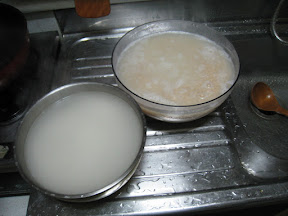
1) Mix long-grain white rice and urad dahl, 2:1. (1 cup of rice and 1/2 a cup of dahl will make enough batter for about 20 idli, or maybe 6 dosai.)

2) Soak for 24 hours. Make sure to put in plenty of water, since lots of it will get absorbed. (You can start with hot water to make sure it all gets soft.)


3) Blend mixture together until it's a bit foamy and not too grainy. Add water slowly, lest it get too runny.


4) Add more water and soak for another 24 hours. You should be able to smell a little sour scent - this means it's fermenting properly.

The batter can be preserved in this state -if the ambient temperature isn't too hot, you can leave the batter out for a few days, while if it's warm, you can store it for a week or so in the fridge.

To turn the batter into idli:

5a) Start boiling a bit of water in a large pot, or pressure cooker if you have one.

6a) Use a little bit of oil to grease your idli steamer trays (visible in my hands there.)


7a) Spoon out a bit of broth into each idli mold.

8a) Stack your trays up and start steaming. Be vigilant about the water level - if it touches the idli, they'll get soggy, but if it all evaporates, you'll probably burn the pan.


9a) In a non-pressurized, covered pot, it should take about 10 minutes. I suppose less in a pressure cooker.

10a) Take them out, slide them out of the tray, and start over at 6a).

Or, to make dosai:

5b) Heat a little bit of oil in a thick skillet.

6b) Drop in a ladlefull of batter - not too thick.


7b) Fry, flip, and fry again.

That's the end. Now all you need is something to eat them with. I suggest...

Inviting 25 friends and telling them each to bring something Indian-ish. Chutney, sambar, curry, any of the north Indian stuff mentioned above.


It will help if a third of them are from the motherland.


Clear off your computer desk and set out a buffet.


Chow down!

Sunday, January 30, 2011

nice nice nice

Not much to write about of late.

My Scottish coworker and the-better-part-of-a-year cynic and vegetarian buddy Andy left the country after three years. The week preceding his departure was full of plantnappings, furniture nabbing, pancake gorging, and rice wine till 6AM. One fine night, five of us went through eleven kettles of rice wine and one of each pancake on the menu (spicy chive, green onion, potato, kimchi, split pea, sesame leaf) except cabbage. There was much talk about death, breathing, zen, the grave, goodbyes, environmentalism, Sadhana, and some other slightly-less-couth topics.

Tobin, a fellow American whom I met in Sadhana Forest, took his sweet time meandering around India, Nepal, Tibet, China, Japan, and Seoul, and finally made it to his real destination (my living room) sometime around the middle of the month. He hung out for a week, had a really great time (if I may say so), participated in the first ever giant party in my house (25 person, hundred dosa, thousand idli [admitted overstatement] Indian potluck), and then headed off about a week ago. I hesitate to write about the experience because, for one, I am pretty sure he'll be reading this at some point, and, for two, because he's just that sort of friend that one has nothing but loads of good stuff to say about, and I'm generally not comfortable giving other people compliments (i.e. I give them to myself quite well), and particularly not in front of an audience as GIGANTIC as mine (proof).

The very next day, a pair of Couchsurfers arrived from Colombia. Jorge and Isabel. Jorge's now staying in what was once Tobin's spot, while Isabel is staying with another host nearby. I've been enjoying showing them around town, taking them to meet my friends at excellent restaurants, cooking various foods from them - from Korean to Indian to random stuff from my fridge - learning about Colombia, and realizing how much my Spanish skills have atrophied since 2002. It's been a bit of a burden having guests for about a whole two weeks now, but it's also been really nice to reconnect with an old friend, meet someone new, and share my life and time and food and social circles and bathroom day-in and day-out.

Then, this morning, I headed back to my old neighborhood (Chilgok, where I lived in '07-'08) and met up with Mr. Kim, the manager of the "Farmer's Marketplace." Back in March or so I saw the store while on the bus and have been frequenting it since then. When I got the bright idea to start showing films, I started dropping off advertisements there, even though foreigners hardly visit and middle-aged Korean women who do the shopping for their family are never going to come to my Saturday-night screenings. The cashier lady asked me once, nicely, why I bothered biking around and doing screenings and if I wasn't just tiring myself out, and without thinking I told her that I just mostly felt compelled, that I didn't know what else I would do if I weren't doing "this." (I learned an important fact about myself at that moment.) We talked briefly about how pitiful we are in contrast to the influence of major agro-corporations, then I put the minipumpkins and sweet potatoes in my bike bag and pedalled off.

Sometime in December - I remember because it was the first big snow of this winter - I stopped by again to do some shopping on my way to meet a friend. It was some sort of customer appreciation day, so after brushing the flakes off my ridiculous orange parka, the cashier lady took me to the back of the store, where pork was a-grillin'. I enjoyed a bit of grilled rice cake and kimchi and some homemade rice wine that hadn't been fermented quite as long as it should have, and wound up meeting the manager, along with a local artist, a former school principal, and some other guy, all related to the Daegu eco-scene in some way or another. Now that I write this, I'm pretty sure I've mentioned it before, in the post about things coming together.

Anyhow, it was on that day that Mr. Kim said that we should have tea together. And it was at that moment that he explained to me that the Korean phrase "let's have tea" means something like "maybe we have something in common, let's try to get to know one another," whereas "let's have a meal" means "let's cement this relationship" and "let's have a drink" means maybe something along the lines of "let's get drunk and vent and then make some plans." I accepted and vague tea-related promises were made.

Actually, though, I think it's a little weird just to have tea, so I called Mr. Kim last night and arranged a lunch meet for today. I grabbed the bus out to Chilgok, gave myself nausea trying to finish the appendix to Benedict Anderson's Imagined Communities: Reflections on the Origin and Spread of Nationalism, did a little shopping at the Marketplace, then was taken to "Nok-ya-won," an awesome little restaurant I wish I had known about back in 2006 when I first came.

They served us green tea, then jeong-sik, which has of late become my favorite kind of Korean meal. Literally "decided meal," jeong-sik is kind of like the soup du jour, except that rather than soup it's 10 or 15 or 20 vegetable side dishes served with rice. The specific dishes vary according to the restaurant, the location, the season, the prices at the market, and I suppose the cook's whims and specialities. Included in today's lunch:

-Noodles and radish in vinegar/red pepper sauce
-Black rice and mushroom porridge
-Sticky sweet potato noodles with sliced vegetables
-Sauteed mushrooms
-Thin-tofu soup
-Slightly stronger tofu in red pepper paste
-Sweetened dried radish
-Sesame leaf kimchi
-Sweet lotus root
-Grated carrots, bean sprouts, and spinach
-Doraji (some awesome root) in a sweet red pepper sauce
-Donnamul (little crisp leafy guys, stem and all) in a thin soybean paste and onion sauce
-Some little fishies
-Just a tiny bit of steamed pork, leaves, and dip
-An awesome kind of sliced root with peanut sauce, which I had never tried before
-Another vegetable with some crazy seasoning I can't begin to describe.
-And I think two or three more that I can't quite recall.
-Not to mention that the rice - multi-grain, with pumpkin and sunflower seeds and ginko nuts too - was wrapped up in a lotus leaf and then steamed.

My lord, it was good. And Mr. Kim paid (12 bucks each) while I was in the bathroom.

While eating, we talked about Mr. Kim's path from anti-goverment demonstration in his college days to a few years doing politics with an independent party to (I'm not sure, my Korean isn't anywhere near as good as I'm making it out to be) to finally operating this marketplace and trying to raise environmental awareness through volunteer programs, farmstays, movies, and other strategies. We also talked about the communities I'm intending to visit in the coming weeks, and how so may aspects of community here have collapsed, that most people don't even realize it, and what the best way to go about addressing that problem is. I explained to him what WWOOFing was and offered to connect him to my persimmon farmer down South, and he offered to connect me to some "famous" environmentalists around here who do documentaries and other things that I didn't really understand. I asked him if he knew about CSAs (I hadn't found a Korean farmer yet who did) and he said that actually his marketplace is a sort of CSA and that some of his customers have direct relationships - which means they've met face-to-face and even worked in the fields side-by-side with- the farmers who supply the store. Excellent!

After lunch, he dropped me off at another eco-friendly shop, where I buy my laundry detergent and other stuff. I'm on good, maybe somewhat flirty terms with the (female) manager there, and since I was buying stuff for friends as well as myself, and my bag was stuffed and I probably looked pathetic (the nausea still hadn't/hasn't gone away), she gave me a solid 20k won discount (on a 70k won basket of goodies) even though I've never bothered signing up for a membership card.

She also introduced me to the guy behind me in line at the checkout counter, who happens to be a farmer on the mountain nearby. He also happens to be one of the store's suppliers for soybean paste, red pepper paste, and other fermented foodstuffs. She told him I was interested in farming, and within 30 seconds of meeting me he offered to let me come to his farm and check out both his organic plots, where he grows enough to feed his family, and his processing facilities. He also offered to give me a ride home. Equal parts nauseous and grateful, I accepted.

On the way home we chatted about this and that; his 11-month old son, his time in Australia, his farm in the mountains, his family, Korean hospitality, his sister's Canadian husband eating really spicy peppers, how Finnish people can't handle kimchi, the virtues of raising your own food, what to plant come April, how nice sweet potatoes are, and so forth.

What I draw from this is that, even though I feel ridiculous sometimes [edit: most of the time], talking to people about this "group" called Daegu Green Living that is still at this point just me, throwing around flyers indiscriminately, chatting with owners, interviewing interns, writing articles, taking pictures of foods and signs and postponing putting them up on the web, it really does seem like a lot has come of it. Things and opportunities I didn't expect and couldn't have predicted in advance. The more I put myself out there - sharing my opinion, making efforts to fix things, deciding not to hide my values - the more I seem to meet and connect with similar people. And the more those people seem to respect me and want to help me and connect me to other people they know. I suppose it shouldn't really come as a surprise, since there's no way any of this could happen if I just sat around in my little turtle-shell of a home studying Korean (which I do do sometimes). Nonetheless, it's pleasant. It's nice that, despite all the things that make me curmudgeonly (see recent post about Foot and Mouth, as well as my recurring references to Jensen and probably most posts with the "Wisdom" label), there are
people in my immediate vicinity who share my concerns and ideals and hopes and frustrations. It's also nice to know that there are more people than I know of who are, in their own ways, going about doing the sort of stuff I am.

I don't know what else to say. Just, "nice."

Friday, January 14, 2011

Tobin said sometimes it seems like I'm holding back when I write

For the last month or so, I’ve been working harder than I’ve worked in years to prepare for the Upo Wetlands English Ecology Camp, which was originally planned to take place this weekend. I was surprised, both pleasantly and not, by the amount of time and effort that one has to put into doing things that matter. The work has included: 3-plus-hour trips via train, bus, and car, sometimes all three in one morning, to reach the camp site; long and frustrating meetings with budget people from the government; lectures about why government funding is so complicated and why it might be reasonable that they refuse to buy us pastels rather than crayons; nights spent sleeping in rooms so cold that even my three layers on top weren’t enough, so I slept in my parka; and being so tired and busy and worn out that I even ate a grilled Wonderbread and Kraft Singles sandwich. Thankfully, I didn’t get to the point where I would eat cup ramen, but it wasn’t far off.

I don’t want to paint a negative picture of the camp, because I believe that, however short and whatever the effort put into it (actually, in all likelihood, because of that very effort), it will be one of the best things I’ve done in Korea, both for me and for others. It has given me lots to chew on regarding various incarnations of the environmentalist (farmer, conservationist, organizer, educator, bureaucrat, practitioner) and various obstacles to conservation, and has helped me to think about what kind of action makes me happy, what kind makes me feel useful, and what kind makes me frustrated. Most importantly, I’ve met several new and impressive people who are working in their own ways towards their own ends, which are necessary compliments to mine. I respect them greatly and look forward to networking, if not just plain working, with them again in the future.

This post was supposed to happen on Monday, and was supposed to be full of pictures of kids meditating in the “Secret Garden,” checking out displays and dioramas in the ecology center, biking around the wetland banks, and looking at constellations and making up their own stories. Instead, the post is happening today and will center on the evils and ironies of, surprise, modern meat production. Usually, I don’t write too much about these things, because I don’t think of myself as any more of an expert than anyone else. Perhaps I’ve read a little more (though some readers definitely have me beat here), but nothing in my particular experience makes me more affected by global warming or the Texas-sized plastic island in the middle of the Pacific than you.

But, this time, it’s personal.

While the point of the camp – not in the minds of those who conceived it, and not even to me – was never to convince kids to go vegetarian, I do think that hours spent:

- watching migratory birds go through one phase of their life cycle,
- learning all about wetland ecology and the complexity and multiplicity of relationships between land, climate, plants, animals, and people,
- seeing the conditions even of relatively fortunate livestock,
- talking with farmers,
- cooking sweet potatoes together over a fire,

and on other such activities that we had planned for the kids, could only have served to increase their feeling of connection to and responsibility for nature, both of which underly my dedication to conservation, which itself underlies my vegetarianism. Thus, it strikes me as ironic that the (most) recent outbreak of foot and mouth disease in Southern South Korea, which is almost certainly due to the ruthlessly cramped, unbelievably filthy, and inarguably inhumane (or shall we say “efficient?”) conditions that livestock are raised in, caused someone somewhere higher up to postpone the camp. It wouldn’t surprise me if the postponement eventually became a cancellation.

When reading environmental literature, one often sees discussions of feedback loops, where one cause’s effect affects the cause in turn, resulting in more of the same, perhaps ad infinitum, or perhaps just to the end, wherever that may be. (I don’t think I want to find out.) For example, increased air and ocean temperatures increase the rate at which the ice caps are melting; the resulting water, which as ice reflected a certain amount of the sun’s rays, now absorbs more of them, leading to further heating. Which leads to more melting. And more heating. And so forth. The foot-and-mouth outbreak (fiasco? travesty?) seems to me to be another, more human-centered version of the feedback loop. Because of said outbreak:

- people tend to think of animals as dirty and dangerous; they want eggs that didn’t come out of a chicken’s butt*, pork chops that that didn’t come out of a pig’s side, and milk from a cow that isn’t pregnant, so...
- the government makes stricter laws regarding animal facilities, NOT to actually improve the health of animals or people [if this were the goal, the government could, say, limit the maximum number of animals a farm can raise to number it can keep healthy without drugs, or the number it can feed with its own grass, or the number of individual animals the CEO in question can identify] but rather to convince consumers (and perhaps themselves) that their meat will be clean and safe to ingest. I say this because compliance with these laws generally requires purchasing new equipment (e.g. for cleaner slaughter or processing) or using new technologies (e.g. antibiotics), both of which cost money and may not be viable options for small-scale farmers, so...
- Said small farmers go out of business, often ceding their land and customers to larger entities, which relate to customers through advertisements and images, not through direct contact. This means that people who already have little incentive to go see the condition of the animals from which, like it or not, animal products come from, now lack even the opportunity to do so...
- The gap between producer and consumer, both in terms of physical distance and in terms of knowledge about the origin and nature of the product, widens. The only thing supermarket shoppers know about meat is its price; this is all the producers want us to know, and mostly, we are content to know no more, so...
- Producers have undeniable economic incentive to treat the animals even worse (or shall we say, “more efficiently?”), cramming them into smaller cages and pens, feeding them even cheaper food (often waste products from the same or other operations), and pumping them full of other drugs, all of which practices devastate the animals’ health and reduce their capacity to resist pathogens, so...
- Outbreaks of diseases (if not Foot and Mouth, then perhaps Mad Cow or Avian Influenza) become more regular, and probably more serious, so...
- People tend to think of animals as dirty and dangerous; they want eggs that didn’t come out of a chicken’s butt, pork chops that that didn’t come out of a pig’s side, and milk from a cow that isn’t pregnant, so...
- You get the point.

The personal element is the following: in my humble opinion, the only way out of this cycle is for consumers to know more – ideally, everything – about what they’re consuming. Most of us, understandably, give up on this desire, if we ever feel it in the first place. How much can you explain about your plumbing, your TV, your car, your phone, your breakfast cereal, even your banana? Did you know bananas grow upside-down? Or maybe it's more sensible to say that we eat them upside-down?

The point is, the camp, or something like it, is a sine qua non; it may not in itself be a way out of our lifestyle of half-willful, half-imposed ignorance, but it is at least a start. Without it, without camps and other events like it, without the people who planned it and without people like them, I see little chance for change. We need more programs that take kids** away from their TVs, their Nintendos, their cell phones (did I mention that during the camp, there would have been no video games, no cell phones, no instant food, no paper cups, no plastic bottles or aluminum cans, and pretty much nothing else to throw out?), their bags of chips, their cans of Coke, and yes, even their school books. We spend our days living in an environment almost entirely of our own making. Even the trees and flowers we pass are decorative and not meaningful parts of an ecosystem. If not for the sky and wind, we might never have to confront nature at all. We all, and children in particular, need to break out of this cycle if we are to take seriously the limits that our environment places on us. Breaking out of this cycle requires spending time in nature, learning to learn with our eyes and ears and skin, not just with books. Spending time in nature gives us both the desire and the fortitude necessary to resist the forces that have brought us to such a precarious position. So, as much as I feared actually taking responsibility for my curriculum, my students, and my actions, I am infinitely more disappointed now that the chance has been taken away from me.

Of course the disease is a tragedy for consumers, who run the (quite small) risk of eating contaminated meat and facing side effects such as ____________. [I should admit: I wrote this without knowing the side effects, or much at all about the disease. Then I went to look up the side effects, so I could make the post more dramatic, only to find that "Humans are very rarely affected" and that "it is a much greater threat to the agriculture industry than to human health." Apparently, the most significant effect of the disease, from the human standpoint, is reduced milk production in cows and the death of pigs that could otherwise be turned into meat.] It’s also a tragedy for small farmers, who will find it much harder to recover from culling twelve percent of their stock than large corporations with other sources of income will. Let’s not forget to mention that it’s a tragedy for all the animals who suffer fevers, blisters, secretions, swollen testicles, and then, must be culled by being buried alive, since spilling their blood might spread the infection. It’s a tragedy for wild animals, who may catch the diseases in question, and therefore for other animals and plants that depend on those animals, and those that depend on those, and so on. It’s a tragedy for future generations of animals, who will likely grow up on farms even more dystopian than their parents’. The only people, the only beings, who may look at the outbreak as anything other than a tragedy, are those who caused it in the first place, since they are the ones who will comply with the government regulations, consolidate smaller enterprises, and continue progressing towards monopoly. On second thought, it’s probably also good for those who make the regulations, too. On third thought, I suppose it's good for the virus itself. Small comfort.

There is a line Jensen uses over and over throughout Endgame, as well as in other works. Like Jensen, if I may be forgiven for making the comparison, I use this line because I hardly even know what actions I should take myself, so I’m not going to pretend to know about anyone else’s capacities, beliefs, inclinations, etc. What’s best for me, and what’s necessary where I am, is not likely to be what’s best for you or for wherever you are. There’s no room for prescription. And there are enough problems that it’s not even necessary. The line is, the question is:

What are you going to do about it?


__________________________________________

*I am pretty sure I’m stealing this image from Casaubon’s Book
** Adults, too.

I